

[2026] Pass ASQ CMQ-OE Exam in First Attempt Easily
The Most Efficient CMQ-OE Pdf Dumps For Assured Success
What is the duration of the CMQ-OE Exam
- Number of Questions: 165
- Format: Multiple choices, multiple answers
- Length of Examination: 4 hour 30 minutes
NEW QUESTION # 222
A quality inspector who has worked in the quality assurance department for five years goes to the quality manager and asks what is necessary to advance into a p as a quality If the y has adopted a TQM approach, the quality manager should respond in which of the following ways?
- A. ''We should meet to discuss your needs and desires and a specific attainment plan.
- B. "You will need to get more training to increase your skills"
- C. "You are doing a great job where you are, and you should have no problem advancing in the organization."
- D. "We should talk with a representative in the Human Resources Department about positions in that area."
Answer: A
Explanation:
When an employee expresses interest in advancing their career, especially within a Total Quality Management (TQM) approach, it is essential to engage in a constructive conversation. The quality manager should encourage open communication and explore the employee's aspirations, skills, and development needs. By suggesting a meeting to discuss needs and desires, the manager can create a personalized plan that aligns with the employee's goals and organizational requirements. This approach fosters employee engagement, professional growth, and strategic alignment within the TQM framework2.
References:
* ASQ Certified Manager of Quality/Organizational Excellence Handbook, Fourth Edition (Page 1)
* ASQ Certified Manager of Quality/Organizational Excellence
NEW QUESTION # 223
Performance appraisals and coaching techniques are most effective when they are combined to
- A. rank the workforce for pay increases or promotions
- B. Evaluate the performance of individual duals on a team
- C. discipline at-risk employees
- D. lead employees to higher levels of performance
Answer: D
NEW QUESTION # 224
A stakeholder analysis would:
- A. Provide the basis to recommend the best strategy for dealing with pressure from a competitor.
- B. Assess the feasibility of a partnership with a key supplier.
- C. Delineate the outputs and outcomes needed by customers and regulatory agencies affecting the
business. - D. Determine the appropriate dividend amount to be distributed to shareholders.
Answer: C
NEW QUESTION # 225
An organization should use which of the following resources as guidance on quality-related issues?
- A. Quality policies
- B. Quality assurance requirements
- C. Process capability studies
- D. Hoshin planning
Answer: A
Explanation:
Quality policies serve as the foundation for an organization's quality management system. They articulate the organization's commitment to quality, customer satisfaction, and continuous improvement. Here's why quality policies are essential:
* Strategic Alignment: Quality policies align with the organization's overall strategic goals and objectives. They guide decision-making and actions at all levels.
* Stakeholder Expectations: Quality policies address the expectations of stakeholders, including customers, employees, regulators, and shareholders.
* Consistency: Quality policies promote consistency in processes, practices, and behaviors across the organization.
* Framework for Objectives: They provide a framework for setting quality objectives and measuring performance.
* Communication: Quality policies communicate the organization's quality values and principles to all employees.
While process capability studies, Hoshin planning, and quality assurance requirements are valuable tools and approaches, quality policies are fundamental and should be the starting point for quality-related guidance.
: 1: The ASQ Certified Manager of Quality/Organizational Excellence Handbook, Fifth Edition1.
NEW QUESTION # 226
Process improvement teams should receive training in which of the following topics?
- A. Complaint resolution
- B. Safety-related requirements
- C. Problem-solving
- D. Conflict management
Answer: C
NEW QUESTION # 227
A company's area director is upset that quality levels have not improved since a quality training session was held a month ago. The area director tells the quality manager to schedule additional training as soon as possible In response the quality should do which of the following first?
- A. Ask the trainers to redesign the content of the training before delivering it again
- B. Explain to the employees who were trained a month ago the importance of improving the quality levels
- C. Ask the trainers for data showing the impact their course has had on quality levels at other companies
- D. Discuss with the trainer's possible reasons why the quality levels have not improved
Answer: D
NEW QUESTION # 228
The primary purpose of a supplier certification program is to:
- A. Reduce the number of supplier audits.
- B. Shift costs of supplier management from appraisal to prevention.
- C. Reward excellent suppliers.
- D. Transfer responsibility for supplier quality to the purchasing department.
Answer: B
NEW QUESTION # 229
The most significant concern about using off-the-shelf software for statistical process control (SPC) analysis is the
- A. resistance to automating a system that currently uses human monitoring
- B. large number of charts that need to be analyzed
- C. misapplication of SPC results and incorrect conclusions
- D. reduced need for training in SPC tools and concepts
Answer: C
NEW QUESTION # 230
Which of the following tools is used to help organize the output from a brainstorming session?
- A. Affinity diagram
- B. Interrelationship digraph
- C. Tree diagram
- D. Activity network diagram
Answer: A
NEW QUESTION # 231
Which of the following tools is used to clarify roles and track accountability between activities and related stakeholders?
- A. Affinity diagram
- B. Deployment flow chart
- C. Prioritization matrix
- D. Gant chart
Answer: B
Explanation:
The Deployment flow chart is a valuable tool for visualizing the flow of activities, responsibilities, and accountabilities within a process or project. It helps clarify roles by mapping out who is responsible for each task or step. By using symbols and arrows, the flow chart illustrates the sequence of activities and the relationships between different stakeholders. This tool ensures that everyone involved understands their roles and responsibilities, which is essential for effective process management and project execution3.
:
ASQ Certified Manager of Quality/Organizational Excellence
ASQ Certified Manager of Quality/Organizational Excellence (CMQ/OE) | ASQ India ASQ Certified Manager of Quality/Organizational Excellence
NEW QUESTION # 232
In a balanced scorecard, which of the following figures is an example of a measure from the Learning and growth perspective?
- A. Revenue per employee
- B. Retention numbers
- C. Mean time between failures
- D. Market share
Answer: B
Explanation:
The balanced scorecard is a strategic management tool that views the organization from different perspectives. One of these perspectives is the Learning and growth perspective, which focuses on how the organization fosters ongoing change and continuous improvement. Measures related to employee development, training, and retention fall under this perspectiveRetention numbers specifically reflect the organization's ability to retain skilled and valuable employees, which contributes to long-term success and growth12.
: 1: The ASQ Certified Manager of Quality/Organizational Excellence Handbook, Fourth Edition, Russell
T. Westcott (Editor), ASQ Quality Press, 2013. 2: What is a Balanced Scorecard? BSC Quality Example | ASQ
NEW QUESTION # 233
Understanding leadership requires a fundamental understanding of organizations and the design factors that must be considered. The design of an organization is the formal framework for communication and authority, and is determined by:
- A. Centralization and complexity
- B. Formalization and centralization
- C. Formalization, centralization and complexity
- D. Formalization, centralization and outsourcing
Answer: C
NEW QUESTION # 234
The Vice President (VP) for quality has attended a series of employee and management focus groups and has discovered that not all team members believe they are being supported by their respective managers. Further analysis shows that some managers have not yet attended training on the basic principles of quality. Which of the following would be the most effective way for the VP to reinforce the management training on the basic quality principles?
- A. Develop a presentation on the basic quality principles for managers to deliver to their departments
- B. Work with line management to get managers involved with teams immediately after training
- C. Regularly publish the names of all managers who have completed the training in the company's quality newsletter
- D. Identify several of the trained managers for individual awards
Answer: B
NEW QUESTION # 235
A recent employee survey included individual comments indicating that some employees are having to decide whether to follow a written procedure or do something contrary to procedure b their supervisor or manager told them to do it differently. In this situation, the first action the quality manager should take is to
- A. initiate appropriate changes to the procedures being violated
- B. discuss the matter with the quality council or senior management
- C. discuss the matter with mid-level managers
- D. quantify and verify the survey findings
Answer: B
Explanation:
When faced with conflicting information between written procedures and instructions from supervisors or managers, the quality manager should engage in open communication. Discussing the matter with mid-level managers allows for clarification, understanding the context, and addressing any discrepancies. It is essential to seek alignment and resolve conflicts through effective communication within the organization. Once the issue is understood, appropriate actions, such as updating procedures or providing additional guidance, can be taken1.
:
ASQ Certified Manager of Quality/Organizational Excellence Handbook, Fourth Edition (Page 1)
NEW QUESTION # 236
The following charts represent the defects reported by the ABC Manufacturing: Company. Customer X and Customer Y both received the same amounts of components from ABC.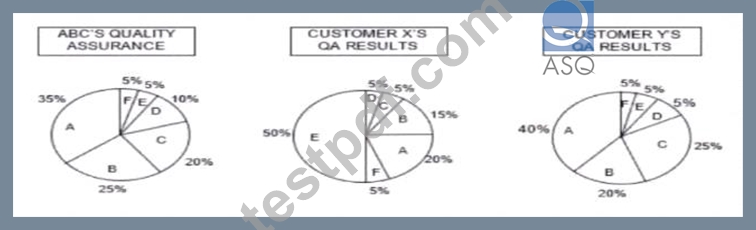
- A. organize a quality team to continue to reduce the percentage of defect type A tor customer Y
- B. begin in-house inspections of all products lo monitor for defect type A
- C. organize a quality learn to solve the problem with defect type B
- D. begin in-house inspections of all products to monitor for any defect types
Answer: A
Explanation:
Unfortunately, the comprehensive and detailed explanation based on the ASQ Certified Manager Of Quality/Organizational Excellence study guide and handbook is not available in the provided information.
References:
* ASQ Certified Manager Of Quality/Organizational Excellence Certification
* The Certified Manager of Quality/Organizational Excellence Handbook, Fourth Edition (PDF)
* The ASQ Certified Manager of Quality/Organizational Excellence Handbook, Fifth Edition (eBook)
* The ASQ Certified Manager of Quality/Organizational Excellence Handbook
NEW QUESTION # 237
......
We offers you the latest free online CMQ-OE dumps to practice: https://www.testpdf.com/CMQ-OE-exam-braindumps.html
ASQ CMQ-OE Real Exam Questions Guaranteed Updated Dump: https://drive.google.com/open?id=16A01xC4ZPsFutzrMidAFcX48mJ5lqV5Y
