

Read Online SC-300 Test Practice Test Questions Exam Dumps
Easily To Pass New SC-300 Premium Exam Updated [Apr 09, 2026]
NEW QUESTION # 106
You have an Azure AD tenant that contains the users shown in the following table.
The tenant has the authentication methods shown in the following table.
Which users will sign in to cloud apps by matching a number shown in the app with a number shown on their phone?
- A. User1 and User2 only
- B. User1 only
- C. User2 only
- D. User2 and User3 only
- E. User3 only
Answer: B
NEW QUESTION # 107
You need to create the LWGroup1 group to meet the management requirements.
How should you complete the dynamic membership rule? To answer, drag the appropriate values to the correct targets. Each value may be used once, more than once, or not at all. You many need to drag the split bar between panes or scroll to view content.
NOTE: Each correct selection is worth one point.
Answer:
Explanation:
NEW QUESTION # 108
Your company has an Azure Active Directory (Azure AD) tenant named contoso.com. The company has a business partner named Fabrikam, Inc.
Fabrikam uses Azure AD and has two verified domain names of fabrikam.com and litwareinc.com. Both domain names are used for Fabrikam email addresses.
You plan to create an access package named package1 that will be accessible only to the users at Fabrikam.
You create a connected organization for Fabrikam.
You need to ensure that the package1 will be accessible only to users who have fabrikam.com email addresses.
What should you do? To answer, select the appropriate options in the answer area.
NOTE:Each correct selection is worth one point.
Answer:
Explanation:
Reference:
https://docs.microsoft.com/en-us/azure/active-directory/governance/entitlement-management-access-package-request-policy
https://docs.microsoft.com/en-us/azure/active-directory/governance/entitlement-management-access-package-create
NEW QUESTION # 109
You have a custom cloud app named App1 that is registered in Azure Active Directory (Azure AD).
App1 is configured as shown in the following exhibit.
Use the drop-down menus to select the answer choice that completes each statement based on the information presented in the graphic.
NOTE: Each correct selection is worth one point.
Answer:
Explanation:
Reference:
https://docs.microsoft.com/en-us/azure/active-directory/manage-apps/assign-user-or-group-access-portal
NEW QUESTION # 110
Your network contains an on-premises Active Directory Domain services (AD DS) domain that syncs with an Azure AD tenant. The AD DS domain contains the organizational units (OUs) shown in the following table.
You need to create a break-glass account named BreakGlass.
Where should you create BreakGlass, and which role should you assign to BreakGlass? To answer, select the appropriate options in the answer area.
NOTE: Each correct selection is worth one point.
Answer:
Explanation:
Explanation
D:\mudassar\Untitled.jpg
NEW QUESTION # 111
You have a Microsoft 365 E5 tenant.
You purchase a cloud app named App1.
You need to enable real-time session-level monitoring of App1 by using Microsoft Cloud app Security.
Which four actions should you perform in sequence? To answer, move the appropriate actions from the list of actions to the answer area and arrange them in the correct order.
Answer:
Explanation:
1 - Publish App1 in Azure Active Directory (Azure AD).
2 - From Microsoft Cloud App Security, modify the Connected apps settings for.App1.
3 - From Microsoft Cloud App Security, create a session policy.
4 - Create a conditional access policy that has session controls configured.
Reference:
https://docs.microsoft.com/en-us/cloud-app-security/proxy-deployment-any-app
https://docs.microsoft.com/en-us/cloud-app-security/session-policy-aad
NEW QUESTION # 112
You have a Microsoft 365 subscription that contains the users shown in the following table.
From the tenan1, you configure a naming policy for groups.
Which users are affected by the naming policy?
- A. User1, User2, User3, and User4
- B. User3 and User4 only
- C. User2 only
- D. User1, User2, and User3 only
- E. User3only
- F. User2 and User3 only
Answer: B
Explanation:
According to the Microsoft Identity and Access Administrator (SC-300) Study Guide and the Microsoft Learn
- "Manage Microsoft 365 Groups naming policies" documentation, group naming policies in Azure Active Directory (now Microsoft Entra ID) apply to end users who create Microsoft 365 groups, but do not apply to administrators who have roles that allow them to override naming restrictions.
The policy defines conventions such as prefixes, suffixes, blocked words, and enforced naming rules.
However, certain administrative roles are exempt from this policy to allow organizational management and automation processes. The exempt roles are:
* Global Administrator
* User Administrator
These two roles can create Microsoft 365 groups without the naming policy constraints. Other users - including Groups Administrator and users without administrative roles - are subject to the naming policy when creating groups.
From the official documentation:
"Naming policies apply to all users who create groups, except for global administrators and user administrators. These roles can create groups that bypass the naming policy restrictions." Applying this rule:
* User1 (Global Administrator) - exempt
* User2 (User Administrator) - exempt
* User3 (Groups Administrator) - affected by the policy
* User4 (no role) - affected by the policy
NEW QUESTION # 113
Note: This question is part of a series of questions that present the same scenario. Each question in the series contains a unique solution that might meet the stated goals. Some question sets might have more than one correct solution, while others might not have a correct solution.
After you answer a question in this section, you will NOT be able to return to it. As a result, these questions will not appear in the review screen.
You have an Azure Active Directory (Azure AD) tenant that syncs to an Active Directory forest.
You discover that when a user account is disabled in Active Directory, the disabled user can still authenticate to Azure AD for up to 30 minutes.
You need to ensure that when a user account is disabled in Active Directory, the user account is immediately prevented from authenticating to Azure AD.
Solution: You configure conditional access policies.
Does this meet the goal?
- A. Yes
- B. No
Answer: B
Explanation:
Azure Active Directory (Azure AD) Pass-through Authentication allows your users to sign into both on-premises and cloud-based applications using the same passwords. It uses a lightweight on-premises agent that listens for and responds to password validation requests. If disabled user can not login.
Reference:
https://docs.microsoft.com/en-us/answers/questions/3221/disable-account-sync.html
NEW QUESTION # 114
Your network contains an on-premises Active Directory domain named contoso.com. The domain contains the objects shown in the following table.
You install Azure AD Connect. You configure the Domain and OU filtering settings as shown in the Domain and OU Filtering exhibit. (Click the Domain and OU Filtering tab.)
You configure the Filter users and devices settings as shown in the Filter Users and Devices exhibit. (Click the Filter Users and Devices tab.)
For each of the following statements, select Yes if the statement is true. Otherwise, select No.
Answer:
Explanation:
Reference:
https://docs.microsoft.com/en-us/azure/active-directory/hybrid/how-to-connect-install-custom
NEW QUESTION # 115
You have a Microsoft Entra tenant that contains the users shown in the following table.
You have an administrative unit named Au1.Group1, User2, and User3are members of Au1.
User5 is assigned the User Administrator role for Au1.
For which users can User5 reset passwords?
- A. User3 and User4 only
- B. User1, User2, and User3
- C. User2 and User3 only
- D. User1 and User2 only
Answer: C
NEW QUESTION # 116
You have an Azure AD tenant that contains multiple storage accounts.
You plan to deploy multiple Azure App Service apps that will require access to the storage accounts.
You need to recommend an identity solution to provide the apps with access to the storage accounts. The solution must minimize administrative effort.
Which type of identity should you recommend, and what should you recommend using to control access to the storage accounts? To answer, select the appropriate options in the answer area.
Answer:
Explanation:
Explanation:
NEW QUESTION # 117
You have a Microsoft 365 tenant.
Sometimes, users use external, third-party applications that require limited access to the Microsoft 365 data of the respective user. The users register the applications in Azure Active Directory (Azure AD).
You need to receive an alert if a registered application gains read and write access to the users' email.
What should you do? To answer, select the appropriate options in the answer area.
NOTE: Each correct selection is worth one point.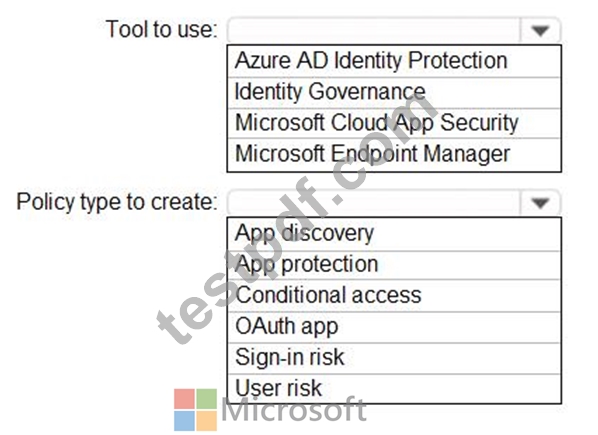
Answer:
Explanation:
Reference:
https://docs.microsoft.com/en-us/cloud-app-security/app-permission-policy
NEW QUESTION # 118
You have an Azure Active Directory (Azure AD) tenant.
You configure self-service password reset (SSPR) by using the following settings:
- Require users to register when signing in: Yes
- Number of methods required to reset: 1
What is a valid authentication method available to users?
- A. a Microsoft Teams chat
- B. a smartcard
- C. an email to an address outside your organization
- D. an FID02 security token
Answer: C
Explanation:
The following authentication methods are available for SSPR (self-service password reset)
- app notification
- Mobile app code
- Email
- Mobile phone
- Office phone (available only for tenants with paid subscriptions)
- Security questions
https://learn.microsoft.com/en-us/azure/active-directory/authentication/concept-sspr-howitworks
NEW QUESTION # 119
You have a Microsoft 365 tenant that uses the domain named fabrikam.com. The Guest invite settings for Azure Active Directory (Azure AD) are configured as shown in the exhibit. (Click theExhibittab.)
A user named [email protected] shares a Microsoft SharePoint Online document library to the users shown in the following table.
Which users will be emailed a passcode?
- A. User1, User2, and User3
- B. User2 only
- C. User1 and User2 only
- D. User1 only
Answer: B
Explanation:
Reference:
https://docs.microsoft.com/en-us/azure/active-directory/external-identities/one-time-passcode
NEW QUESTION # 120
You have an Azure subscription that uses Azure AD Privileged Identity Management (PIM).
You need to identify users that are eligible for the Cloud Application Administrator role.
Which blade in the Privileged Identity Management settings should you use?
- A. Azure resources
- B. Review access
- C. Azure AD roles
- D. Privileged access groups
Answer: D
NEW QUESTION # 121
Note: This question is part of a series of questions that present the same scenario. Each question in the series contains a unique solution that might meet the stated goals. Some question sets might have more than one correct solution, while others might not have a correct solution.
After you answer a question in this section, you will NOT be able to return to it. As a result, these questions will not appear in the review screen.
You have a Microsoft 365 tenant.
You have 100 IT administrators who are organized into 10 departments.
You create the access review shown in the exhibit. (Click the Exhibit tab.)
You discover that all access review requests are received by Megan Bowen.
You need to ensure that the manager of each department receives the access reviews of their respective department.
Solution: You set Reviewers to Member (self).
Does this meet the goal?
- A. Yes
- B. No
Answer: B
NEW QUESTION # 122
......
Microsoft SC-300 certification exam is designed for professionals seeking to validate their expertise in managing identity and access in Microsoft Azure environments. As Microsoft's cloud-based services continue to grow in popularity, organizations need professionals who can manage access and identities to ensure secure and efficient operations. SC-300 exam is designed to test the candidate's ability to implement and manage identity and access solutions in Microsoft Azure environments, which includes the management of user identities, access controls, and authentication protocols.
Schedule exam
Languages: English, Japanese, Chinese (Simplified), Korean
Retirement date: none
This exam measures your ability to accomplish the following technical tasks: implement an identity management solution; implement an authentication and access management solution; implement access management for apps; and plan and implement an identity governance strategy.
SC-300 Certification All-in-One Exam Guide Apr-2026: https://www.testpdf.com/SC-300-exam-braindumps.html
Get Real SC-300 Exam Dumps [Apr-2026] Practice Tests: https://drive.google.com/open?id=1R587Zh8FVKaIRj5GOfe_0U8GtLzWET5v
