

2021 Valid 300-420 test answers & Cisco Exam PDF
Free Cisco 300-420 Exam Questions & Answer from Training Expert TestPDF
Cisco 300-420 Exam Topics:
| Section | Weight | Objectives |
|---|---|---|
| Advanced Enterprise Campus Networks | 25% | - Design campus networks for high availability
-Design campus Layer 2 infrastructures
-Design multicampus Layer 3 infrastructures
-Describe SD-Access Architecture (underlay, overlay, control and data plane, automation, wireless, and security) |
| Automation | 10% | - Choose the correct YANG data model set based on requirements -Differentiate between IETF, Openconfig, and Cisco native YANG models -Differentiate between NETCONF and RESTCONF -Describe the impact of model-driven telemetry on the network
-Compare dial-in and dial-out approaches to model-driven telemetry |
| WAN for Enterprise Networks | 20% | -Compare WAN connectivity options
-Design site-to-site VPN
-Design high availability for enterprise WAN
-Describe Cisco SD-WAN Architecture (orchestration plane, management plane, control plane, data plane, on-boarding and provisioning, security) |
| Advanced Addressing and Routing Solutions | 25% | -Create structured addressing plans for IPv4 and IPv6 -Create stable, secure, and scalable routing designs for IS-IS -Create stable, secure, and scalable routing designs for EIGRP -Create stable, secure, and scalable routing designs for OSPF -Create stable, secure, and scalable routing designs for BGP
-Determine IPv6 migration strategies
|
| Network Services | 20% | -Select appropriate QoS strategies to meet customer requirements (DiffServ, IntServ) -Design end-to-end QoS policies
-Design network management techniques
-Describe multicast routing concepts (source trees, shared trees, RPF, rendezvous points) |
NEW QUESTION 51
Drag and drop the description from the left onto the corresponding WAN connectivity types and categories on the right.
Answer:
Explanation:
NEW QUESTION 52 
Refer to the exhibit. An engineer must design an automatic failover solution. The solution should allow HSRP to detect a WAN 1 failure and initiate an automatic failover, making router R2 the active HSRP router. Which two solutions should the engineer choose? (Choose two.)
- A. Implement Enhanced Object Tracking on roster R1
- B. use a floating static route
- C. use IP source routing
- D. Implement IP SLA on router R1
- E. Implement PBR on router R1
Answer: A,D
NEW QUESTION 53
Refer to the exhibit. Area 10 is a regular OSPF area and networks 10.1.1.0/24 and 172.16.1.0/24 are internal. Which design provides optimal routing between both networks when the link between routers C and E fails?
- A. Create an OSPF virtual link between routers E and F.
- B. Move the link between routers C and D to area 10.
- C. Make area 10 a not-so-stubby area.
- D. Create a tunnel between routers E and F in area 10.
Answer: B
NEW QUESTION 54
When a network is designed using IS-IS protocol, which two circuit types are supported? (Choose two.)
- A. point-to-multipoint
- B. nonbroadcast multiaccess
- C. multiaccess
- D. nonbroadcast
- E. point-to-point
Answer: C,E
NEW QUESTION 55
Which design consideration must be made when using IPv6 overlay tunnels?
- A. Overlay tunnels should only be considered as a transition technique toward a permanent solution.
- B. Overlay tunnels that connect isolated IPv6 networks can be considered a final IPv6 network architecture.
- C. Overlay tunnels can be configured only between border devices and require only the IPv6 protocol stack.
- D. Overlay tunneling encapsulates IPv4 packets in IPv6 packets for delivery across an IPv6 infrastructure.
Answer: C
NEW QUESTION 56
Which function are fabric intermediate nodes responsible for in an SD-Access Architecture?
- A. encapsulating user traffic in a VXLAN header including the SGT
- B. mapping EIDs to RLOCs
- C. registering new endpoints in the HTDB
- D. transporting IP packets between edge nodes and border nodes
Answer: D
NEW QUESTION 57
Refer to the exhibit.
An engineer is designing an OSPF network for a client. Requirements dictate that the routers in Area 1 should receive all routes belonging to the network, including EIGRP, except the ones originated in the RIP domain. Which action should the engineer take?
- A. Make the area 1 routers part of area 0.
- B. Make area 1 a NSSA.
- C. Make area 1 a stub.
- D. Make area 1 a standard OSPF area.
Answer: C
NEW QUESTION 58 
Refer to the exhibit. Customers report low video quality and delays when having point-to-point telepresence video calls between the two locations. An architect must optimize a design so that traffic follows the same path for egress and ingress traffic flows. Which technique optimizes the design?
- A. Configure route leaking on the router in area 1.
- B. Configure the high metric on the router in area 4.
- C. Configure route filter on the router in area 4.
- D. Configure route leaking on the router in area 2.
Answer: B
Explanation:
Section: WAN for Enterprise Networks
NEW QUESTION 59
Drag and drop the model driven telemetry characteristics from the left onto the mode they belong to on the right.
Answer:
Explanation:
NEW QUESTION 60
A router running ISIS is showing high CPU and bandwidth utilization. An engineer discovers that the router is configured as L1/L2 and has L1 and L2 neighbors. Which step optimizes the design to address the issue?
- A. Configure each interface as either L1 or L2 circuit type
- B. Make this router a DIS for each of the interfaces
- C. Disable the default behavior of advertising the default route on the L1/L2 router
- D. Configure the router to be either L1 or L2
Answer: A
Explanation:
Section: Advanced Addressing and Routing Solutions
Explanation/Reference:
NEW QUESTION 61
A customer with an IPv4 only network topology wants to enable IPv6 connectivity while preserving the IPv4 topology services. The customer plans to migrate IPv4 services to the IPv6 topology, then decommission the IPv4 topology. Which topology supports these requirements?
- A. NAT64
- B. dual stack
- C. 6VPE
- D. 6to4
Answer: B
Explanation:
Section: Advanced Addressing and Routing Solutions
NEW QUESTION 62 
Refer to the exhibit. Which two solutions maximize the use of the links between the core and distribution layers? (Choose two.)
- A. use an IGP
- B. use multiple unequal-cost links
- C. use HSRP
- D. use RPVSTP+
- E. use multiple equal-cost links
Answer: A,E
Explanation:
Section: Advanced Enterprise Campus Networks
NEW QUESTION 63
Which design consideration must be made when dual vEdge routers are deployed at a branch site?
- A. Use BGP AS-path prepending to influence egress traffic and use MED to influence ingress traffic from the branch.
- B. Configure BFD between vEdge routers to detect sub-second link failures.
- C. HSRP priorities must match the OMP routing policy to prefer one vEdge over the other.
- D. Traffic must be symmetrical as it egresses the vEdges and returns from remote sites for DPI to function properly.
Answer: A
NEW QUESTION 64
An engineer must design a scalable QoS architecture that allows the separation of the traffic into classes on predefined business requirements. The design must also utilize the differentiated services code points as the QoS priority descriptor value and support at least 10 levels of classification. Which QoS technology should the engineer include in the design?
- A. InterServ
- B. Best Effort
- C. DiffSery
- D. RSVP
Answer: C
Explanation:
Section: Network Services
NEW QUESTION 65
Which two steps can be taken to improve convergence in an OSPF network? (Choose two.)
- A. Span the same IP network across multiple areas.
- B. Make all non-backbone areas stub areas
- C. Use Bidirectional Forwarding Detection
- D. Tune OSPF parameters
- E. Merge all the areas into one backbone area
Answer: B,D
NEW QUESTION 66
Refer to the exhibit. MTU has been configured as shown, and no MTU command has been configured on the tunnel interfaces. It has been found that fragmentation is occurring when tunneled packets are placed onto the IPv6 underlay network. Which configuration change will resolve this problem?
- A. Increase the MTU on the IPv4 networks
- B. Set the MTU to 1476 on the tunnel interfaces
- C. Set the MTU to 1500 on the tunnel interfaces
- D. Increase the MTU on the IPv6 network
Answer: B
NEW QUESTION 67
Refer to the exhibit.
EIGRP has been configured on all links. The spoke nodes have been configured as EIGRP stubs, and the WAN links to R3 have higher bandwidth and lower delay than the links to R4. When a link failure occurs at the R1-R2 link, what happens to traffic on R1 that is destined for a subnet attached to R2?
- A. R1 forwards the traffic to R3, but R3 drops the traffic
- B. R1 forwards the traffic to R3 in order to reach R2
- C. R1 has no route to R2 and drops the traffic
- D. R1 load-balances across the paths through R3 and R4 to reach R2
Answer: B
NEW QUESTION 68
Which control-plane technology allows the same subnet to exist across multiple network locations?
- A. ISE mobility services
- B. VXLAN
- C. FabricPath
- D. LISP
Answer: D
NEW QUESTION 69
An engineer is designing an EIGRP network for a small branch site where there is only one Layer 3 router. The engineer wants the router to advertise the local LAN network to remote EIGRP neighbors without sending any unnecessary multicast messages on the local LAN. Which action should the engineer take?
- A. Redistribute the local LAN network using the redistribute connected command
- B. Advertise the local LAN using the network command and the passive-interface feature
- C. Use a static default route for this site instead of EIGRP
- D. Advertise the local LAN subnet as a stub network
Answer: B
Explanation:
Section: Advanced Addressing and Routing Solutions
NEW QUESTION 70
Which two tasks must you perform to configure DHCP snooping on a device? (Choose two.)
- A. Enable DHCP packet validation on the device
- B. Enable VRF support for the DHCP relay agent
- C. Enable DHCP snooping on the VLAN
- D. Enable DHCP option 82
- E. Enable DHCP snooping globally
Answer: C,E
Explanation:
Explanation/Reference: https://www.cisco.com/c/en/us/td/docs/switches/datacenter/sw/4_1/nx-os/security/configuration/ guide/sec_nx-os-cfg/sec_dhcpsnoop.html
NEW QUESTION 71
A network engineer must connect two sites across a public network using a secure tunneling technology that supports multicast traffic. Which technology must be chosen?
- A. GRE over IPsec
- B. PPTP
- C. GRE
- D. IPsec
Answer: A
NEW QUESTION 72
A network solution is being designed for a company that connects to multiple Internet service providers. Which Cisco proprietary BGP path attribute will influence outbound traffic flow?
- A. Weight
- B. Community
- C. AS Path
- D. MED
- E. Local Preference
Answer: A
NEW QUESTION 73
Which two steps can be taken to improve convergence in an OSPF network? (Choose two.)
- A. Use Bidirectional Forwarding Detection
- B. Span the same IP network across multiple areas.
- C. Tune OSPF parameters
- D. Make all non-backbone areas stub areas
- E. Merge all the areas into one backbone area
Answer: A,C
NEW QUESTION 74
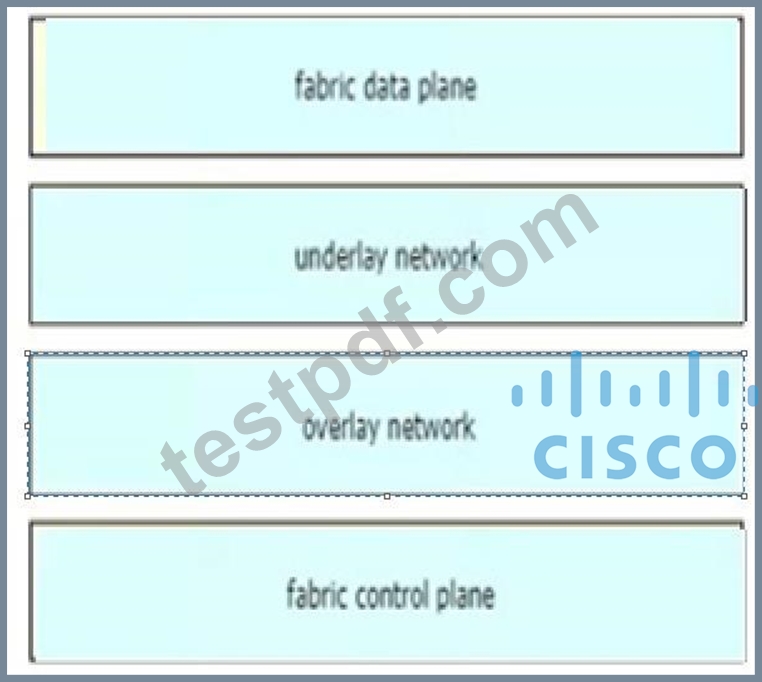
Drag and drop the components in a Cisco SD-Access architecture from the left onto their descriptions on the right.
Answer:
Explanation:
NEW QUESTION 75
Refer to the exhibit. AS65533 and AS65530 are announcing a partial Internet routing table as well as their IP subnets. An architect must create a design that ensures AS64512 become a transit AS. Which filtering solution must the architect choose?
- A. Next-hop
- B. Maximum-prefix
- C. No-advertise
Answer: B
NEW QUESTION 76
......
Topics of Cisco 300-420 Exam
The Cisco 300-420 certification exam validates the students’ knowledge of enterprise design. It covers a wide range of subject areas, such as advanced addressing & routing solutions, security services, WAN, advanced enterprise campus networks, SDA, and network services. The breakdown of these topics into the components of skills to be measured in the test is as follows:
Advanced Routing and Addressing Solutions
About 25% of the exam content is covered in this domain, and the candidates have to perform their skills in the following tasks:
- Creating the structured addressing strategies for both IPv6 & IPv4;
- Developing the scalable, stable, and secure routing design for EIGRP, IS-IS, BGP, OSPF.
Top Cisco 300-420 Courses Online: https://www.testpdf.com/300-420-exam-braindumps.html
300-420 Practice Dumps - Verified By TestPDF Updated 148 Questions: https://drive.google.com/open?id=1Sveel89qeS3FYu17zQXbk4hDIkGwmuD7
