

Achieve The Utmost Performance In DP-100 Exam Pass Guaranteed
Achive your Success with Latest Microsoft DP-100 Exam
Skills Covered
To nail DP-100, you will need to scrutinize the below-mentioned areas:
- Execute Experiments & Train Models
This objective imparts updated understanding about the concepts like creating models by using Azure ML Designer, custom code modules in Designer, defining a pipeline data flow, and an experiment running by using Azure Machine Learning SDK.
- Deploy and Consume Models
The last segment is all about deployment and consumption models. Topics like evaluating compute options, creating production compute targets, batch inferencing pipeline creation, and running this pipeline efficiently are well covered within such a scope.
- Set up Azure ML Workspace
The first domain gives considerable attention to skills related to the Azure ML workspace. So, the test-takers have a chance to learn about workspace settings, the management of workspace using Azure ML, and registering in addition to maintaining the datastores.
- Manage and Optimize Models
Using automated ML for the optimal model creation, hyperdrive to tune hyperparameters, model management, and knowing the crucial model explainers to interpret models are some of the key topics explained in this portion.
NEW QUESTION # 222
You are using a decision tree algorithm. You have trained a model that generalizes well at a tree depth equal to 10.
You need to select the bias and variance properties of the model with varying tree depth values.
Which properties should you select for each tree depth? To answer, select the appropriate options in the answer area.
Answer:
Explanation:
References:
https://machinelearningmastery.com/gentle-introduction-to-the-bias-variance-trade-off-in-machine-learning/
NEW QUESTION # 223
Note: This question is part of a series of questions that present the same scenario. Each question in the series contains a unique solution that might meet the stated goals. Some question sets might have more than one correct solution, while others might not have a correct solution.
After you answer a question in this section, you will NOT be able to return to it. As a result, these questions will not appear in the review screen.
You are using Azure Machine Learning to run an experiment that trains a classification model.
You want to use Hyperdrive to find parameters that optimize the AUC metric for the model. You configure a HyperDriveConfig for the experiment by running the following code:
You plan to use this configuration to run a script that trains a random forest model and then tests it with validation data. The label values for the validation data are stored in a variable named y_test variable, and the predicted probabilities from the model are stored in a variable named y_predicted.
You need to add logging to the script to allow Hyperdrive to optimize hyperparameters for the AUC metric.
Solution: Run the following code: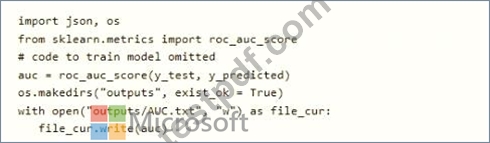
Does the solution meet the goal?
- A. Yes
- B. No
Answer: B
Explanation:
Explanation
Use a solution with logging.info(message) instead.
Note: Python printing/logging example:
logging.info(message)
Destination: Driver logs, Azure Machine Learning designer
Reference:
https://docs.microsoft.com/en-us/azure/machine-learning/how-to-debug-pipelines
NEW QUESTION # 224
You are creating a machine learning model in Python. The provided dataset contains several numerical columns and one text column. The text column represents a product's category. The product category will always be one of the following:
* Bikes
* Cars
* Vans
* Boats
You are building a regression model using the scikit-learn Python package.
You need to transform the text data to be compatible with the scikit-learn Python package.
How should you complete the code segment? To answer, select the appropriate options in the answer area.
NOTE: Each correct selection is worth one point.
Answer:
Explanation:
Explanation
Box 1: pandas as df
Pandas takes data (like a CSV or TSV file, or a SQL database) and creates a Python object with rows and columns called data frame that looks very similar to table in a statistical software (think Excel or SPSS for example.
Box 2: transpose[ProductCategoryMapping]
Reshape the data from the pandas Series to columns.
Reference:
https://datascienceplus.com/linear-regression-in-python/
NEW QUESTION # 225
You are tuning a hyperparameter for an algorithm. The following table shows a data set with different hyperparameter, training error, and validation errors.
Use the drop-down menus to select the answer choice that answers each question based on the information presented in the graphic.
Answer:
Explanation:
Reference:
https://medium.com/comet-ml/organizing-machine-learning-projects-project-management-guidelines-2d2b85651bbd
NEW QUESTION # 226
You are performing feature scaling by using the scikit-learn Python library for x.1 x2, and x3 features.
Original and scaled data is shown in the following image.
Use the drop-down menus to select the answer choice that answers each question based on the information presented in the graphic.
NOTE: Each correct selection is worth one point.
Answer:
Explanation:
Explanation:
Box 1: StandardScaler
The StandardScaler assumes your data is normally distributed within each feature and will scale them such that the distribution is now centred around 0, with a standard deviation of 1.
Example:
All features are now on the same scale relative to one another.
Box 2: Min Max Scaler
Notice that the skewness of the distribution is maintained but the 3 distributions are brought into the same scale so that they overlap.
Box 3: Normalizer
References:
http://benalexkeen.com/feature-scaling-with-scikit-learn/
NEW QUESTION # 227
You have a model with a large difference between the training and validation error values.
You must create a new model and perform cross-validation.
You need to identify a parameter set for the new model using Azure Machine Learning Studio.
Which module you should use for each step? To answer, drag the appropriate modules to the correct steps. Each module may be used once or more than once, or not at all. You may need to drag the split bar between panes or scroll to view content.
NOTE: Each correct selection is worth one point.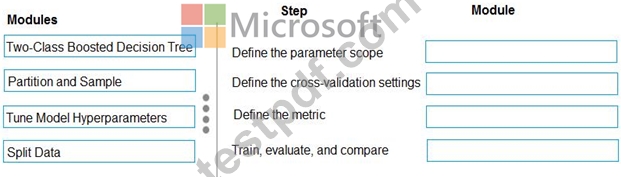
Answer:
Explanation:
Explanation:
Box 1: Split data
Box 2: Partition and Sample
Box 3: Two-Class Boosted Decision Tree
Box 4: Tune Model Hyperparameters
Integrated train and tune: You configure a set of parameters to use, and then let the module iterate over multiple combinations, measuring accuracy until it finds a "best" model. With most learner modules, you can choose which parameters should be changed during the training process, and which should remain fixed.
We recommend that you use Cross-Validate Model to establish the goodness of the model given the specified parameters. Use Tune Model Hyperparameters to identify the optimal parameters.
References:
https://docs.microsoft.com/en-us/azure/machine-learning/studio-module-reference/partition-and-sample
NEW QUESTION # 228
You create a binary classification model by using Azure Machine Learning Studio.
You must tune hyperparameters by performing a parameter sweep of the model. The parameter sweep must meet the following requirements:
* iterate all possible combinations of hyperparameters
* minimize computing resources required to perform the sweep
You need to perform a parameter sweep of the model.
Which parameter sweep mode should you use?
- A. Random grid
- B. Sweep clustering
- C. Entire grid
- D. Random sweep
Answer: A
Explanation:
Explanation
Explanation:
Maximum number of runs on random grid: This option also controls the number of iterations over a random sampling of parameter values, but the values are not generated randomly from the specified range; instead, a matrix is created of all possible combinations of parameter values and a random sampling is taken over the matrix. This method is more efficient and less prone to regional oversampling or undersampling.
If you are training a model that supports an integrated parameter sweep, you can also set a range of seed values to use and iterate over the random seeds as well. This is optional, but can be useful for avoiding bias introduced by seed selection.
Incorrect Answers:
B: If you are building a clustering model, use Sweep Clustering to automatically determine the optimum number of clusters and other parameters.
C: Entire grid: When you select this option, the module loops over a grid predefined by the system, to try different combinations and identify the best learner. This option is useful for cases where you don't know what the best parameter settings might be and want to try all possible combination of values.
Reference:
https://docs.microsoft.com/en-us/azure/machine-learning/studio-module-reference/tune-model- hyperparameters
NEW QUESTION # 229
You are retrieving data from a large datastore by using Azure Machine Learning Studio.
You must create a subset of the data for testing purposes using a random sampling seed based on the system clock.
You add the Partition and Sample module to your experiment.
You need to select the properties for the module.
Which values should you select? To answer, select the appropriate options in the answer area.
NOTE: Each correct selection is worth one point.
Answer:
Explanation:
Explanation:
Box 1: Sampling
Create a sample of data
This option supports simple random sampling or stratified random sampling. This is useful if you want to create a smaller representative sample dataset for testing.
1. Add the Partition and Sample module to your experiment in Studio, and connect the dataset.
2. Partition or sample mode: Set this to Sampling.
3. Rate of sampling. See box 2 below.
Box 2: 0
3. Rate of sampling. Random seed for sampling: Optionally, type an integer to use as a seed value.
This option is important if you want the rows to be divided the same way every time. The default value is 0, meaning that a starting seed is generated based on the system clock. This can lead to slightly different results each time you run the experiment.
References:
https://docs.microsoft.com/en-us/azure/machine-learning/studio-module-reference/partition-and-sample
NEW QUESTION # 230
You arc I mating a deep learning model to identify cats and dogs. You have 25,000 color images.
You must meet the following requirements:
* Reduce the number of training epochs.
* Reduce the size of the neural network.
* Reduce over-fitting of the neural network.
You need to select the image modification values.
Which value should you use? To answer, select the appropriate Options in the answer area.
NOTE: Each correct selection is worth one point.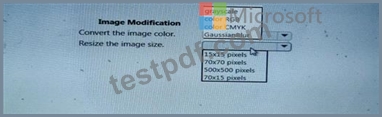
Answer:
Explanation:
NEW QUESTION # 231
You configure a Deep Learning Virtual Machine for Windows.
You need to recommend tools and frameworks to perform the following:
Build deep rwur.il network (DNN) models.
Perform interactive data exploration and visualization.
Which tools and frameworks should you recommend? To answer, drag the appropriate tools to the correct tasks. Each tool may be used once, more than once, or not at all. You may need to drag the split bar between panes or scroll to view content.
NOTE: Each correct selection is worth one point.
Answer:
Explanation:
NEW QUESTION # 232
You have an Azure blob container that contains a set of TSV files. The Azure blob container is registered as a datastore for an Azure Machine Learning service workspace. Each TSV file uses the same data schema.
You plan to aggregate data for all of the TSV files together and then register the aggregated data as a dataset in an Azure Machine Learning workspace by using the Azure Machine Learning SDK for Python.
You run the following code.
For each of the following statements, select Yes if the statement is true. Otherwise, select No.
NOTE: Each correct selection is worth one point.
Answer:
Explanation:
Explanation:
Box 1: No
FileDataset references single or multiple files in datastores or from public URLs. The TSV files need to be parsed.
Box 2: Yes
to_path() gets a list of file paths for each file stream defined by the dataset.
Box 3: Yes
TabularDataset.to_pandas_dataframe loads all records from the dataset into a pandas DataFrame.
TabularDataset represents data in a tabular format created by parsing the provided file or list of files.
Note: TSV is a file extension for a tab-delimited file used with spreadsheet software. TSV stands for Tab Separated Values. TSV files are used for raw data and can be imported into and exported from spreadsheet software. TSV files are essentially text files, and the raw data can be viewed by text editors, though they are often used when moving raw data between spreadsheets.
Reference:
https://docs.microsoft.com/en-us/python/api/azureml-core/azureml.data.tabulardataset
NEW QUESTION # 233
You have a dataset that contains over 150 features. You use the dataset to train a Support Vector Machine (SVM) binary classifier.
You need to use the Permutation Feature Importance module in Azure Machine Learning Studio to compute a set of feature importance scores for the dataset.
In which order should you perform the actions? To answer, move all actions from the list of actions to the answer area and arrange them in the correct order.
Answer:
Explanation:
Explanation
Step 1: Add a Two-Class Support Vector Machine module to initialize the SVM classifier.
Step 2: Add a dataset to the experiment
Step 3: Add a Split Data module to create training and test dataset.
To generate a set of feature scores requires that you have an already trained model, as well as a test dataset.
Step 4: Add a Permutation Feature Importance module and connect to the trained model and test dataset.
Step 5: Set the Metric for measuring performance property to Classification - Accuracy and then run the experiment.
Reference:
https://docs.microsoft.com/en-us/azure/machine-learning/studio-module-reference/two-class-support-vector-mac
https://docs.microsoft.com/en-us/azure/machine-learning/studio-module-reference/permutation-feature-importan
NEW QUESTION # 234
You create an Azure Machine Learning compute target named ComputeOne by using the STANDARD_D1 virtual machine image.
You define a Python variable named was that references the Azure Machine Learning workspace. You run the following Python code:
For each of the following statements, select Yes if the statement is true. Otherwise, select No.
NOTE: Each correct selection is worth one point.
Answer:
Explanation:
Explanation:
Box 1:Yes
ComputeTargetException class: An exception related to failures when creating, interacting with, or configuring a compute target. This exception is commonly raised for failures attaching a compute target, missing headers, and unsupported configuration values.
Create(workspace, name, provisioning_configuration)
Provision a Compute object by specifying a compute type and related configuration.
This method creates a new compute target rather than attaching an existing one.
Box 2: Yes
Box 3: No
The line before print('Step1') will fail.
Reference:
https://docs.microsoft.com/en-us/python/api/azureml-core/azureml.core.compute.computetarget
NEW QUESTION # 235
You define a datastore named ml-data for an Azure Storage blob container. In the container, you have a folder named train that contains a file named data.csv. You plan to use the file to train a model by using the Azure Machine Learning SDK.
You plan to train the model by using the Azure Machine Learning SDK to run an experiment on local compute.
You define a DataReference object by running the following code:
You need to load the training data.
Which code segment should you use?

- A. Option A
- B. Option D
- C. Option E
- D. Option B
- E. Option C
Answer: C
Explanation:
Example:
data_folder = args.data_folder
# Load Train and Test data
train_data = pd.read_csv(os.path.join(data_folder, 'data.csv'))
Reference:
https://www.element61.be/en/resource/azure-machine-learning-services-complete-toolbox-ai
NEW QUESTION # 236
You create a multi-class image classification deep learning model that uses a set of labeled images. You create a script file named train.py that uses the PyTorch 1.3 framework to train the model.
You must run the script by using an estimator. The code must not require any additional Python libraries to be installed in the environment for the estimator. The time required for model training must be minimized.
You need to define the estimator that will be used to run the script.
Which estimator type should you use?
- A. SKLearn
- B. TensorFlow
- C. Estimator
- D. PyTorch
Answer: D
Explanation:
Explanation
For PyTorch, TensorFlow and Chainer tasks, Azure Machine Learning provides respective PyTorch, TensorFlow, and Chainer estimators to simplify using these frameworks.
Reference:
https://docs.microsoft.com/en-us/azure/machine-learning/how-to-train-ml-models
NEW QUESTION # 237
You are producing a multiple linear regression model in Azure Machine learning Studio.
Several independent variables are highly correlated.
You need to select appropriate methods for conducting elective feature engineering on all the data.
Which three actions should you perform in sequence? To answer, move the appropriate Actions from the list of actions to the answer area and arrange them in the correct order.
Answer:
Explanation:
NEW QUESTION # 238
A coworker registers a datastore in a Machine Learning services workspace by using the following code:
You need to write code to access the datastore from a notebook.
Answer:
Explanation:
Explanation
Box 1: DataStore
To get a specific datastore registered in the current workspace, use the get() static method on the Datastore class:
# Get a named datastore from the current workspace
datastore = Datastore.get(ws, datastore_name='your datastore name')
Box 2: ws
Box 3: demo_datastore
Reference:
https://docs.microsoft.com/en-us/azure/machine-learning/how-to-access-data
NEW QUESTION # 239
......
Revolutionary Guide To Exam Microsoft Dumps: https://www.testpdf.com/DP-100-exam-braindumps.html
The DP-100 Exam Test For Brief Preparation: https://drive.google.com/open?id=1UhluEJpUNeRLKC0iypGfAqcQTil-TtLU
