

[Feb 06, 2024] Get New CTSC Practice Test Questions Answers
CTSC Dumps and Exam Test Engine
NEW QUESTION # 45
One major performance outcome of a digital supply chain transformation is:
- A. greater employee retention rate and job satisfaction.
- B. fewer trade-offs between costs and customer satisfaction.
- C. higher net promoter score and lower cost of customer acquisition.
- D. lower selling, general, and administrative (SG&A) expenses of the business.
Answer: B
Explanation:
Explanation
According to the CTSC Enterprise and Supply Chain Management (ESCM) manual, one major performance outcome of a digital supply chain transformation is fewer trade-offs between costs and customer satisfaction1.A digital supply chain transformation is the use of digital technology and digital content to improve supply chain performance2.It enables a flexible matrix of supply chain partners, instead of one upstream and one downstream echelon2.It also enhances information sharing, visibility, decision making, and responsiveness2.By leveraging digital capabilities, a supply chain can achieve higher levels of efficiency, agility, and innovation, while meeting or exceeding customer expectations1.This reduces the need to compromise on either costs or customer satisfaction, and creates a competitive advantage for the supply chain1.
1: https://www.ascm.org/ctsc-ecm/2:
https://www.hclspdev.com/cdn/ascm2023/files/ctsc_slides/ASCM_CTSC_2023_1.pdf
NEW QUESTION # 46
The first step in performing a root cause analysis using the SCOR model involves:
- A. decomposing performance attributes.
- B. establishing process benchmarks.
- C. identifying sources of deviation.
- D. linking processes to metric hierarchy.
Answer: D
Explanation:
Explanation
According to the CTSC exam content manual1, the first step in performing a root cause analysis using the SCOR model involves linking processes to metric hierarchy, which means mapping the SCOR processes to the SCOR metrics and identifying the relevant performance attributes and levels. This step helps to establish the scope and boundaries of the analysis and to align the processes with the strategic objectives of the organization.
NEW QUESTION # 47
A manufacturing company has identified a bottleneck in the production process that is affecting product quality and customer satisfaction. Which of the following total quality management (TQM) principles would be most relevant to address this issue?
- A. Employee involvement
- B. Continuous improvement
- C. Process management
- D. Leadership
Answer: B
NEW QUESTION # 48
Which supply chain model can handle high demand during peak season and quickly adjust to a lean period with low demand?
- A. Agile chain
- B. Flexible chain
- C. Custom-configured chain
- D. Efficient chain
Answer: A
Explanation:
Explanation
According to the CTSC Exam Content Manual, an agile chain is a supply chain model that can handle high demand during peak season and quickly adjust to a lean period with low demand1.An agile chain is characterized by high responsiveness, flexibility, and adaptability to changing customer needs and market conditions1.An agile chain can also cope with high levels of uncertainty and variability in demand and supply1. The other options are not the best supply chain model for this scenario, as they have different characteristics and trade-offs.A custom-configured chain is a supply chain model that delivers customized products or services to customers through modularization and postponement strategies1.A custom-configured chain is suitable for high variety and low volume markets, but it may not be able to handle high demand peaks efficiently2.An efficient chain is a supply chain model that focuses on minimizing costs and maximizing asset utilization through economies of scale and scope1.An efficient chain is suitable for low variety and high volume markets, but it may not be able to adjust quickly to demand fluctuations or customer preferences2.A flexible chain is a supply chain model that can handle moderate changes in demand and supply by adjusting production capacity and inventory levels1.A flexible chain is suitable for medium variety and medium volume markets, but it may not be able to handle extreme demand peaks or lean periods without compromising service levels or costs2.
NEW QUESTION # 49
An organization studying its strategic environment for establishing the scope of its supply chain transformation project must first create a:
- A. value proposition.
- B. SWOT analysis.
- C. business issue repository.
- D. business plan.
Answer: C
Explanation:
Explanation
According to the ASCM CTSC Exam Content Manual, a business issue repository is a tool that helps an organization to study its strategic environment for establishing the scope of its supply chain transformation project.A business issue repository is defined as "a collection of business issues that are identified and prioritized by the organization's leadership team and other key stakeholders"1.A business issue repository helps to align the supply chain transformation objectives with the organization's vision, mission, and strategy, and to identify the gaps and opportunities for improvement in the current supply chain performance1.A business issue repository also helps to communicate the rationale and benefits of the transformation to the internal and external stakeholders, and to monitor and measure the progress and outcomes of the transformation1.
1: ASCM CTSC Exam Content Manual, page 14.
NEW QUESTION # 50
When developing risk plans for supply chain segments, which of the following product categories should have the most complete and thorough risk mitigation plans?
- A. Important products that must be kept cold
- B. Important products where there is a single available supplier
- C. Important products that are government regulated
- D. Important products that require ocean transport for delivery
Answer: B
Explanation:
Explanation
According to the ASCM CTSC Exam Content Manual, one of the factors that influences the risk exposure of a supply chain segment is the availability of alternative sources of supply (p. 20). If there is only one available supplier for an important product, the supply chain segment is more vulnerable to disruptions and uncertainties, such as supplier failure, quality issues, price fluctuations, or geopolitical events. Therefore, this product category should have the most complete and thorough risk mitigation plans, which may include strategies such as developing backup suppliers, increasing inventory buffers, diversifying sourcing locations, or implementing contractual agreements.
NEW QUESTION # 51
When tasked with developing a transformational supply chain strategy, it is important to start with:
- A. identifying and documenting external megatrends.
- B. prioritizing actions and assessing their effectiveness.
- C. determining the customers' current and future needs.
- D. scanning and assessing the competitor landscape.
Answer: C
Explanation:
Explanation
According to the ASCM CTSC Exam Content Manual, one of the first steps in developing a transformational supply chain strategy is to "determine the current and future needs and expectations of the customers, and align the supply chain strategy with the business strategy and customer value proposition" (p. 16). This helps to ensure that the supply chain transformation is customer-centric and focused on delivering value to the end users. The other options are also important, but they should be done after the initial determination of the customers' needs.
NEW QUESTION # 52
A firm seeking to foster mutually beneficial relationships with its stakeholders while using the pillars of sustainability should consider ecology, economics, and:
- A. culture.
- B. risk.
- C. leadership.
- D. ethics.
Answer: D
Explanation:
Explanation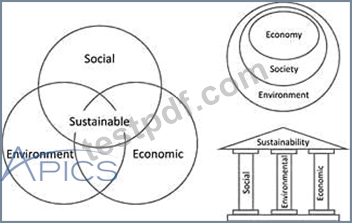
Sustainability
Explore
one of the components of the Enterprise Standards for Sustainability is ethics. Ethics refers to the principles and values that guide the behavior and decisions of an organization and its stakeholders. Ethics is important for fostering mutually beneficial relationships with stakeholders, as it involves respecting human rights, ensuring fair trade, preventing corruption, and promoting transparency and accountability. Therefore, a firm seeking to use the pillars of sustainability should consider ecology, economics, and ethics. Option A, leadership, is not a pillar of sustainability, but rather a skill or quality that can help achieve sustainability.
Option C, risk, is not a pillar of sustainability, but rather a factor that can affect or be affected by sustainability. Option D, culture, is not a pillar of sustainability, but rather an aspect of social sustainability that relates to the beliefs, norms, and values of a society.
NEW QUESTION # 53
A company implements a new enterprise resource planning (ERP) system in 5 different regions globally.
During ERP deployment, the company realizes that one region structures the product hierarchy significantly differently than the other four regions. What step did this company omit in transforming management?
- A. Developing an organizational mapping
- B. Understanding the relationship between actions
- C. Deploying the five core supply chain management disciplines
- D. Identifying the drivers of current performance
Answer: A
Explanation:
Explanation
According to the ASCM CTSC Exam Content Manual, developing an organizational mapping is one of the steps in transforming management.An organizational mapping is defined as "a tool that helps to identify the current and future state of the organization's structure, roles, responsibilities, and reporting relationships"1. An organizationalmapping can help to ensure alignment and consistency across different regions, functions, and processes, and to identify and resolve any gaps or conflicts that may arise during the transformation. By omitting this step, the company failed to recognize and address the difference in the product hierarchy among the regions, which could lead to problems in data integration, reporting, and analysis in the new ERP system.
NEW QUESTION # 54
Which of the following approaches is best for a company looking to become more adaptable to better combat market changes?
- A. Ensure activities across the value system align and synchronize.
- B. Implement technology to support collaborative relationships.
- C. Use redundancy strategies to prepare for potential disruptions.
- D. Review the business strategies and the executions periodically.
Answer: A
NEW QUESTION # 55
Organizational roles and responsibilities should focus on which of the following areas to clarify who is responsible and accountable for each supply chain activity after the transformation initiative is complete?
- A. Sales, accounting, and engineering
- B. Sales, product management, and product development
- C. Sales, operations, and logistics
- D. Product management, product development, and quality
Answer: C
Explanation:
Explanation
According to the ASCM, one of the key steps in supply chain transformation is to define the organizational roles and responsibilities for each supply chain activity, and to ensure that they are aligned with the business strategy and customer expectations1.The ASCM also suggests that the supply chain activities can be grouped into three main categories: sales, operations, and logistics2.These categories reflect the core functions of the supply chain, from planning and executing the demand and supply, to delivering the products and services to the customers2. Therefore, organizational roles and responsibilities should focus on these three areas to clarify who is responsible and accountable for each supply chain activity after the transformation initiative is complete. Some examples of the roles and responsibilities in each area are:
Sales: Responsible for generating and managing the customer demand, forecasting the sales volume, and ensuring customer satisfaction and loyalty.Examples of roles are sales manager, account manager, customer service representative, and demand planner2.
Operations: Responsible for producing and sourcing the products and services, managing the inventory and quality, and optimizing the cost and efficiency.Examples of roles are operations manager, production manager, procurement manager, and quality manager2.
Logistics: Responsible for transporting and distributing the products and services, coordinating with the suppliers and carriers, and ensuring the delivery speed andreliability.Examples of roles are logistics manager, warehouse manager, transportation manager, and distribution manager2.
NEW QUESTION # 56
A smartwatch seller wants to determine how many units of a new model release are required to be held as finished goods and how many units should be held as work-in-process (WIP) stock leading to the new model launch date. Which of the following analyses will allow the manufacturer to calculate the required stock levels to avoid backlogs, inventory losses, and other issues?
- A. Prescriptive analysis
- B. Scenario-based analysis
- C. Descriptive analysis
- D. Predictive analysis
Answer: B
NEW QUESTION # 57
When planning to reduce distribution costs, which of the following factors is important to include in the calculation?
- A. Cost of implementing the new materials flow network
- B. The cost of capital in warehousing
- C. Projected operating cost increases for inventory control
- D. The costs of excess and obsolete inventory
Answer: A
Explanation:
Explanation
According to the CTSC Learning System, one of the factors that affects the distribution costs is the cost of implementing the new materials flow network, which includes the costs of designing, building, and operating the network of warehouses, distribution centers, and transportation modes1.The cost of implementing the new materials flow network can be significant and should be included in the calculation of the total cost of ownership (TCO) of the distribution system1.The other factors listed in the question are not directly related to the distribution costs, but rather to the inventory costs, which are a separate component of the TCO1.
NEW QUESTION # 58
A company seeks to reduce the time between identifying shifts in demand and changing its manufacturing schedule. According to the Digital Capabilities Model (DCM), which digital discipline area within the Demand Planning and Management capability is most directly involved in this objective?
- A. Respond
- B. Collaborate
- C. Optimize
- D. Sense
Answer: A
NEW QUESTION # 59
SCOR metrics for the Sustainability performance attribute are closely aligned with which standards for corporate sustainability reporting?
- A. Corporate Sustainability Reporting Directive (CSRD)
- B. Global Reporting Initiative (GRI) Standards
- C. UNESCO 4 Pillars of Sustainability
- D. Individual Corporate Sustainability Reports
Answer: B
Explanation:
Explanation
According to the CTSC Exam Content Manual1,SCOR metrics for the Sustainability performance attribute are closely aligned with the Global Reporting Initiative (GRI) Standards, which are the most widely used standards for corporate sustainability reporting. The GRI Standards provide a framework and guidance for disclosing information on the economic, environmental, and social impacts of an organization's activities, products, and services. The SCOR metrics for Sustainability include indicators such as greenhouse gas emissions, energy consumption, water consumption, waste generation, and social responsibility.
1: https://www.ascm.org/ctsc-ecm/
NEW QUESTION # 60
A consumer electronics firm finds that its products are experiencing a shrinking product life cycle. What strategy would most directly address this issue?
- A. Accelerate the speed to market.
- B. Increase the velocity in product transitions.
- C. Improve launch predictability.
- D. Focus on revenue maximization.
Answer: A
Explanation:
Explanation
According to the ASCM, one of the challenges of the product life cycle is the shrinking time span between the introduction and decline stages, due to the rapid changes in technology, customer preferences, and competition1.To cope with this challenge, the ASCM recommends that companies adopt a strategy of accelerating the speed to market, which means reducing the time it takes to develop, launch, and deliver new products to customers1.By doing so, companies can gain a competitive advantage, increase customer satisfaction, and capture more market share before the product becomes obsolete1. Some of the ways to accelerate the speed to market are:
Implementing agile and lean product development methods1
Collaborating with suppliers, customers, and other stakeholders in the product design and launch process1 Using digital technologies and platforms to enable faster and more efficient product testing, validation, and feedback1 Optimizing the supply chain network and logistics to ensure timely and reliable product delivery1
NEW QUESTION # 61
Which of the following approaches is best for an organization focused on developing a supply chain leadership mindset?
- A. Encourage cross-team collaboration.
- B. Emphasize the need to maximize profits.
- C. Pursue supply chain growth in lockstep with business growth.
- D. Focus on resource optimization.
Answer: A
Explanation:
Explanation
Ac-cording to the CTSC Exam Content Manual, developing a supply chain leadership mindset involves creating a culture of innovation, learning, and collaboration across the organization. A supply chain leader should encourage cross-team collaboration to leverage the diverse skills, perspectives, and experiences of different stakeholders, and to foster trust, communication, and alignment of goals and objectives. Cross-team collaboration can help the organization to identify and solve problems, generate and implement new ideas, and improve performance and customer satisfaction.
NEW QUESTION # 62
On which type of waste does just-in-time (JIT) manufacturing have the largest impact?
- A. Waiting/Time
- B. Movement
- C. Overproduction/Inventory
- D. Defects
Answer: C
Explanation:
Explanation
Just-in-time (JIT) manufacturing is a production strategy that produces goods based on customer orders and reduces inventory levels by ordering materials only as they are needed for production1. This minimizes the waste of overproduction and inventory, which are the most common and costly forms of waste in manufacturing2. By eliminating excess inventory, JIT manufacturing also reduces the waste of waiting, movement, defects, and overprocessing that are associated with inventory management3.
NEW QUESTION # 63
Which of the following examples represents a risk avoidance strategy?
- A. Postponed product differentiation
- B. Delay of entry into a market or market segment
- C. Mitigation of uncertain market events
- D. Hedging procurement of raw materials
Answer: B
NEW QUESTION # 64
......
2024 New TestPDF CTSC PDF Recently Updated Questions: https://www.testpdf.com/CTSC-exam-braindumps.html
APICS CTSC DUMPS WITH REAL EXAM QUESTIONS: https://drive.google.com/open?id=1C32VtUlp1vcIskQ00eJ6Axb-DdUmyu2m
