

[Feb-2024 Newly Released] Pass 300-910 Exam - Real Questions and Answers
Pass 300-910 Review Guide, Reliable 300-910 Test Engine
Cisco 300-910 exam is a certification test that measures the knowledge and skills of candidates in implementing DevOps solutions and practices using Cisco platforms. DevOps is a set of practices that combines software development and IT operations to improve the speed and quality of software delivery. 300-910 exam is designed for IT professionals who want to demonstrate their expertise in implementing DevOps practices using Cisco technologies, including application programming interfaces (APIs), automation tools, and containerization platforms.
Cisco 300-910 certification exam is a 90-minute test that comprises around 60-70 multiple-choice and simulation-based questions. 300-910 exam is available in English and Japanese, and it can be taken online or at a certified testing center.
NEW QUESTION # 46
Refer to the exhibit.
Which CI solution uses this file?
- A. Travis CI
- B. GitLab CI
- C. Drone
- D. Jenkins
Answer: C
Explanation:
Explanation
syntax for GitLab CI, Travis CI & Jenkins are "stage...", while Drone use "steps..." Here are the configuration files I referred https://docs.drone.io/pipeline/environment/syntax/
https://docs.gitlab.com/ee/ci/yaml/includes.html
https://blog.travis-ci.com/2019-05-30-setting-up-a-ci-cd-process-on-github
https://www.jenkins.io/doc/pipeline/examples/
NEW QUESTION # 47
Which step must be taken to enable centralized logging in a Kubernetes environment?
- A. Deploy a sidecar node that aggregates logs from the entire cluster.
- B. Create a CustomResourceDefinition in each deployment that specifies the IP or names the log collector.
- C. No steps need to be taken. The master node automatically aggregates logs from all worker nodes and stores them on the specified persistent volume.
- D. Create a DaemonSet that deploys a container with a logging agent on every node in the cluster.
Answer: D
Explanation:
Explanation
To enable centralized logging in a Kubernetes environment, you must create a DaemonSet that deploys a container with a logging agent on every node in the cluster. This allows all of the logs from each node to be collected in one place, allowing for easier analysis and management. Reference: Kubernetes Documentation, Logging Architecture.
NEW QUESTION # 48
AppDynamics is being used to monitor your distributed Python application. Each individual container of the application is instrumented with an AppD agent. Which two configuration variables uniquely determine the module being monitored? (Choose two.)
- A. event
- B. node
- C. tier
- D. agent
- E. app
Answer: B,E
Explanation:
Section: Logging, Monitoring, and Metrics
NEW QUESTION # 49
An application has been designed based on microservices. The application is deployed on Kubernetes using multiple pods that share the same IP address. Each pod is responsible for a service in the application.
Which command validates the success of the application deployment?
- A. kubectl rollout history deployment
- B. kubectl get pods -o wide -w
- C. kubectl describe pods/
- D. kubectl rollout status deployment
Answer: D
NEW QUESTION # 50
Which two practices help make the security of an application a more integral part of the software development lifecycle? (Choose two.)
- A. Add a step to the CI/CD pipeline that runs a static code analysis tool during the pipeline execution.
- B. Use only software modules that are written by the internal team.
- C. Ensure that the code repository server has enabled drive encryption and stores the keys on a Trusted Platform Module or Hardware Security Module.
- D. Add a step to the CI/CD pipeline that runs a dynamic code analysis tool during the pipeline execution.
- E. Add a step to the CI/CD pipeline to modify the release plan so that updated versions of the software are made available more often.
Answer: A,D
Explanation:
Adding a step to the CI/CD pipeline that runs a dynamic code analysis tool and a static code analysis tool during the pipeline execution helps make the security of an application a more integral part of the software development lifecycle. Dynamic code analysis tools search for coding errors and vulnerabilities while the application is running, while static code analysis tools scan the source code for potential errors and vulnerabilities. This ensures that any security issues are identified and addressed before the application is deployed. Additionally, using automated tools helps to reduce the amount of manual effort required for security testing and can reduce the risk of security flaws being introduced.
NEW QUESTION # 51
Which step must be taken to enable centralized logging in a Kubernetes environment?
- A. Deploy a sidecar node that aggregates logs from the entire cluster.
- B. Create a CustomResourceDefinition in each deployment that specifies the IP or names the log collector.
- C. Create a DaemonSet that deploys a container with a logging agent on every node in the cluster.
- D. No steps need to be taken. The master node automatically aggregates logs from all worker nodes and stores them on the specified persistent volume.
Answer: A
Explanation:
Section: Cloud and Multicloud
NEW QUESTION # 52
Which Docker command is used to start an interactive Bash shell in a running container named "test"?
- A. docker exec -it test /bin/bash
- B. docker run test /bin/bash
- C. docker run -it test /bin/bash
- D. docker attach -it test /bin/bash
Answer: A
NEW QUESTION # 53
Refer to the exhibit.
What are the properties of the load balancer in a Kubernetes environment?
- A. Forwards any outgoing traffic from the port named nginx-port to exposed ports http-port1 and http-port2 of nginxapp
- B. Has exposed ports 80 and 8080 to a private IP address and directs outgoing connections to the port named http-port1
- C. Has exposed ports 80 and 8080 to a public IP address and directs incoming connections to the port named nginx-port
- D. Forwards incoming traffic from the port named nginx-port to ports 80 and 8080 of nginxapp
Answer: C
NEW QUESTION # 54
How long analysis systems such as Elasticsearch, Logstash, and Kibana Stack handle ingesting unstructured logs from different devices in various formats?
- A. All devices that generate syslogs must use agents that process the local logs and transmit them in a specific format to the ELK Stack.
- B. All logs are stored in their unstructured text format, and the ELK Stack performs data analysis by intelligently parsing the logs using machine learning algorithms.
- C. All different message formats are parsed separately using custom filters, and the resulting structured data is stored for later analysis.
- D. A single, comprehensive log format is defined on the ELK Stack. All incoming logs, regardless of format, are transformed to match the comprehensive format, and only applicable fields are populated.
Answer: C
Explanation:
Explanation
The ELK Stack (Elasticsearch, Logstash, and Kibana) can handle ingesting unstructured logs from various devices in different formats by running custom filters on the logs. The filters are designed to parse the log data and extract the relevant, structured information from it, which is then stored for later analysis. This allows for faster and more accurate analysis of the data, and enables more sophisticated insights to be drawn from it.
NEW QUESTION # 55
Drag and drop the operations from the left into the correct order on the right when using CI/CD, assuming that there are no failures or conflicts.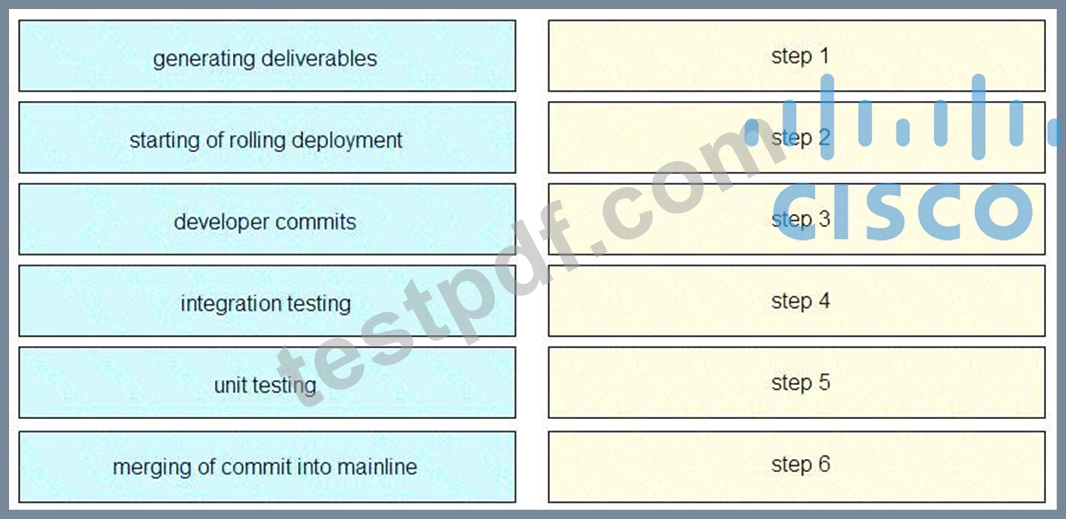
Answer:
Explanation:

NEW QUESTION # 56
A CI/CD pipeline that builds infrastructure components using Terraform must be designed. A step in the pipeline is needed that checks for errors in any of the .tf files in the working directory. It also checks the existing state of the defined infrastructure.
Which command does the pipeline run to accomplish this goal?
- A. terraform fmt
- B. terraform check
- C. terraform validate
- D. terraform plan
Answer: D
Explanation:
Explanation
https://www.terraform.io/docs/cli/commands/validate.html "use the terraform plan command instead, which includes an implied validation check."
NEW QUESTION # 57
Refer to the exhibit.
A developer needs to scale the existing pods within the worked nodes. Which object should be edited to achieve this goal?
- A. Pod
- B. Deployment
- C. PriorityClass
- D. ReplicaSet
Answer: D
NEW QUESTION # 58
Refer to the exhibit.
The exhibit shows the output of an Ansible task that prints the contents of the show_ip_int_brief variable that was registered in a different task in the playbook.
Which expression is used to print the output of the command without its header row?
- A. show_ip_int_brief['stdout_lines'][0]
- B. show_ip_int_brief['stdout_lines']
- C. show_ip_int_brief['stdout_lines'][1:]
- D. show_ip_int_brief['stdout_lines'][0][1:]
Answer: C
NEW QUESTION # 59
Microservices architecture pattern has been applied and the system has been architected as a set of services. Each service is deployed as a set of instances for throughput and availability. In which two ways are these services packaged and deployed? (Choose two.)
- A. Service instances do not need to be isolated from one another.
- B. Service must be dependent, deployable, and scalable.
- C. Service must be independently deployable and scalable.
- D. Service instances must be isolated from one another.
- E. Service are written using the same languages, frameworks, and framework versions.
Answer: C,D
NEW QUESTION # 60
A DevOps engineer is designing a precheck validation of the network state in a CI/CD pipeline and must implement this workflow:
* Take a source Docker image named alpine
* Define two stages named build and push
* Check network connectivity before the stages run
* Fetch the latest Docker image
* Create a new Docker image and push it to the registry
* Tag the new Docker image as the latest version
Drag and drop the code snippets from the bottom onto the boxes in the GitLab CI configuration to achieve the requirements for the design. Not all options are used.
Answer:
Explanation:
Explanation
NEW QUESTION # 61
Refer to the exhibit.
The push_configs.yml playbook returns the error shown.
Which action resolves the error?
- A. Install the Paramiko library on the host that runs Ansible
- B. Comment out the StrictHostKeyChecking=yes line from ansible.cfg
- C. Generate a new SSH key pair and add the public key to the target machine
- D. Export the ANSIBLE_HOST_KEY_CHECKING=False variable
Answer: D
NEW QUESTION # 62
......
Cisco 300-910 exam is an important certification for IT professionals who want to expand their knowledge and skills in DevOps practices and automation in Cisco environments. 300-910 exam covers various topics, including automation tools, DevOps processes, and Cisco technologies. It is a challenging exam that requires candidates to have a strong understanding of the concepts and technologies covered in the exam. However, passing the exam can lead to new career opportunities and enable professionals to take on more challenging roles in their organizations.
100% Free 300-910 Daily Practice Exam With 130 Questions: https://www.testpdf.com/300-910-exam-braindumps.html
300-910 Test Engine Practice Test Questions, Exam Dumps: https://drive.google.com/open?id=1D3goe5g3z6gZbhD6clzGiM5G_USGlraN
