

The Best Practice Test Preparation for the Professional-Machine-Learning-Engineer Certification Exam
Professional-Machine-Learning-Engineer Exam Dumps, Practice Test Questions BUNDLE PACK
Google Professional Machine Learning Engineer certification exam is designed to test individuals’ proficiency in designing and developing scalable machine learning models on Google Cloud Platform. Professional-Machine-Learning-Engineer exam is intended for professionals with experience in implementing and managing machine learning models on the Google Cloud Platform. Google Professional Machine Learning Engineer certification exam focuses on assessing the individual’s ability to design, develop, train, evaluate, and deploy machine learning models.
To be eligible for the Google Professional Machine Learning Engineer certification exam, candidates must have a minimum of three years of experience in the field of machine learning. Candidates should also have experience in designing and implementing machine learning solutions using Google Cloud technologies such as Google Cloud ML Engine, BigQuery, and TensorFlow. In addition to these requirements, candidates should have a strong understanding of machine learning algorithms and data structures.
NEW QUESTION # 106
You are building a custom image classification model and plan to use Vertex Al Pipelines to implement the end-to-end training. Your dataset consists of images that need to be preprocessed before they can be used to train the model. The preprocessing steps include resizing the images, converting them to grayscale, and extracting features. You have already implemented some Python functions for the preprocessing tasks. Which components should you use in your pipeline'?
- A.

- B.

- C.

- D.

Answer: D
NEW QUESTION # 107
You have been asked to build a model using a dataset that is stored in a medium-sized (~10 GB) BigQuery table. You need to quickly determine whether this data is suitable for model development. You want to create a one-time report that includes both informative visualizations of data distributions and more sophisticated statistical analyses to share with other ML engineers on your team. You require maximum flexibility to create your report. What should you do?
- A. Use Dataprep to create the report.
- B. Use Vertex AI Workbench user-managed notebooks to generate the report.
- C. Use the Google Data Studio to create the report.
- D. Use the output from TensorFlow Data Validation on Dataflow to generate the report.
Answer: B
Explanation:
* Option A is correct because using Vertex AI Workbench user-managed notebooks to generate the report is the best way to quickly determine whether the data is suitable for model development, and to create a one-time report that includes both informative visualizations of data distributions and more sophisticated statistical analyses to share with other ML engineers on your team. Vertex AI Workbench is a service that allows you to create and use notebooks for ML development and experimentation. You can use Vertex AI Workbench to connect to your BigQuery table, query and analyze the data using SQL or Python, and create interactive charts and plots using libraries such as pandas, matplotlib, or seaborn.
You can also use Vertex AI Workbench to perform more advanced data analysis, such as outlier detection, feature engineering, or hypothesis testing, using libraries such as TensorFlow Data Validation, TensorFlow Transform, or SciPy. You can export your notebook as a PDF or HTML file, and share it with your team. Vertex AI Workbench provides maximum flexibility to create your report, as you can use any code or library that you want, and customize the report as you wish.
* Option B is incorrect because using Google Data Studio to create the report is not the most flexible way to quickly determine whether the data is suitable for model development, and to create a one-time report that includes both informative visualizations of data distributions and more sophisticated statistical analyses to share with other ML engineers on your team. Google Data Studio is a service that allows you to create and share interactive dashboards and reports using data from various sources, such as BigQuery, Google Sheets, or Google Analytics. You can use Google Data Studio to connect to your BigQuery table, explore and visualize the data using charts, tables, or maps, and apply filters, calculations, or aggregations to the data. However, Google Data Studio does not support more sophisticated statistical analyses, such as outlier detection, feature engineering, or hypothesis testing, which may be useful for model development. Moreover, Google Data Studio is more suitable for creating recurring reports that need to be updated frequently, rather than one-time reports that are static.
* Option C is incorrect because using the output from TensorFlow Data Validation on Dataflow to generate the report is not the most efficient way to quickly determine whether the data is suitable for model development, and to create a one-time report that includes both informative visualizations of data distributions and more sophisticated statistical analyses to share with other ML engineers on your team.
TensorFlow Data Validation is a library that allows you to explore, validate, and monitor the quality of your data for ML. You can use TensorFlow Data Validation to compute descriptive statistics, detect anomalies, infer schemas, and generate data visualizations for your data. Dataflow is a service that allows you to create and run scalable data processing pipelines using Apache Beam. You can use Dataflow to run TensorFlow Data Validation on large datasets, such as those stored in BigQuery.
However, this option is not very efficient, as it involves moving the data from BigQuery to Dataflow, creating and running the pipeline, and exporting the results. Moreover, this option does not provide maximum flexibility to create your report, as you are limited by the functionalities of TensorFlow Data Validation, and you may not be able to customize the report as you wish.
* Option D is incorrect because using Dataprep to create the report is not the most flexible way to quickly determine whether the data is suitable for model development, and to create a one-time report that includes both informative visualizations of data distributions and more sophisticated statistical analyses to share with other ML engineers on your team. Dataprep is a service that allows you to explore, clean, and transform your data for analysis or ML. You can use Dataprep to connect to your BigQuery table, inspect and profile the data using histograms, charts, or summary statistics, and apply transformations, such as filtering, joining, splitting, or aggregating, to the data. However, Dataprep does not support more
* sophisticated statistical analyses, such as outlier detection, feature engineering, or hypothesis testing, which may be useful for model development. Moreover, Dataprep is more suitable for creating data preparation workflows that need to be executed repeatedly, rather than one-time reports that are static.
References:
* Vertex AI Workbench documentation
* Google Data Studio documentation
* TensorFlow Data Validation documentation
* Dataflow documentation
* Dataprep documentation
* [BigQuery documentation]
* [pandas documentation]
* [matplotlib documentation]
* [seaborn documentation]
* [TensorFlow Transform documentation]
* [SciPy documentation]
* [Apache Beam documentation]
NEW QUESTION # 108
You are an ML engineer at an ecommerce company and have been tasked with building a model that predicts how much inventory the logistics team should order each month. Which approach should you take?
- A. Use a time series forecasting model to predict each item's monthly sales. Give the results to the logistics team so they can base inventory on the amount predicted by the model.
- B. Use a clustering algorithm to group popular items together. Give the list to the logistics team so they can increase inventory of the popular items.
- C. Use a regression model to predict how much additional inventory should be purchased each month. Give the results to the logistics team at the beginning of the month so they can increase inventory by the amount predicted by the model.
- D. Use a classification model to classify inventory levels as UNDER_STOCKED, OVER_STOCKED, and CORRECTLY_STOCKED. Give the report to the logistics team each month so they can fine-tune inventory levels.
Answer: C
NEW QUESTION # 109
During batch training of a neural network, you notice that there is an oscillation in the loss. How should you adjust your model to ensure that it converges?
- A. Increase the size of the training batch
- B. Increase the learning rate hyperparameter
- C. Decrease the size of the training batch
- D. Decrease the learning rate hyperparameter
Answer: D
Explanation:
Oscillation in the loss during batch training of a neural network means that the model is overshooting the optimal point of the loss function and bouncing back and forth. This can prevent the model from converging to the minimum loss value. One of the main reasons for this phenomenon is that the learning rate hyperparameter, which controls the size of the steps that the model takes along the gradient, is too high.
Therefore, decreasing the learning rate hyperparameter can help the model take smaller and more precise steps and avoid oscillation. This is a common technique to improve the stability and performance of neural network training12.
References:
* Interpreting Loss Curves
* Is learning rate the only reason for training loss oscillation after few epochs?
NEW QUESTION # 110
Your data science team has requested a system that supports scheduled model retraining, Docker containers, and a service that supports autoscaling and monitoring for online prediction requests. Which platform components should you choose for this system?
- A. Cloud Composer, Vertex AI Training with custom containers, and App Engine
- B. Cloud Composer, BigQuery ML, and Vertex AI Prediction
- C. Vertex AI Pipelines, Vertex AI Prediction, and Vertex AI Model Monitoring
- D. Vertex AI Pipelines and App Engine
Answer: C
Explanation:
* Option A is incorrect because Vertex AI Pipelines and App Engine do not meet all the requirements of the system. Vertex AI Pipelines is a service that allows you to create, run, and manage ML workflows using TensorFlow Extended (TFX) components or custom components1. App Engine is a service that allows you to build and deploy scalable web applications using standard or flexible
* environments2. However, App Engine does not support Docker containers in the standard environment, and does not provide a dedicated service for online prediction and monitoring of ML models3.
* Option B is correct because Vertex AI Pipelines, Vertex AI Prediction, and Vertex AI Model Monitoring meet all the requirements of the system. Vertex AI Prediction is a service that allows you to deploy and serve ML models for online or batch prediction, with support for autoscaling and custom containers4. Vertex AI Model Monitoring is a service that allows you to monitor the performance and fairness of your deployed models, and get alerts for any issues or anomalies5.
* Option C is incorrect because Cloud Composer, BigQuery ML, and Vertex AI Prediction do not meet all the requirements of the system. Cloud Composer is a service that allows you to create, schedule, and manage workflows using Apache Airflow. BigQuery ML is a service that allows you to create and use ML models within BigQuery using SQL queries. However, BigQuery ML does not support custom containers, and Vertex AI Prediction does not support scheduled model retraining or model monitoring.
* Option D is incorrect because Cloud Composer, Vertex AI Training with custom containers, and App Engine do not meet all the requirements of the system. Vertex AI Training is a service that allows you to train ML models using built-in algorithms or custom containers. However, Vertex AI Training does not support online prediction or model monitoring, and App Engine does not support Docker containers in the standard environment or online prediction and monitoring of ML models3.
References:
* Vertex AI Pipelines overview
* App Engine overview
* Choosing an App Engine environment
* Vertex AI Prediction overview
* Vertex AI Model Monitoring overview
* [Cloud Composer overview]
* [BigQuery ML overview]
* [BigQuery ML limitations]
* [Vertex AI Training overview]
NEW QUESTION # 111
You recently developed a deep learning model using Keras, and now you are experimenting with different training strategies. First, you trained the model using a single GPU, but the training process was too slow. Next, you distributed the training across 4 GPUs using tf.distribute.MirroredStrategy (with no other changes), but you did not observe a decrease in training time. What should you do?
- A. Increase the batch size.
- B. Create a custom training loop.
- C. Distribute the dataset with tf.distribute.Strategy.experimental_distribute_dataset
- D. Use a TPU with tf.distribute.TPUStrategy.
Answer: D
NEW QUESTION # 112
You recently deployed a pipeline in Vertex Al Pipelines that trains and pushes a model to a Vertex Al endpoint to serve real-time traffic. You need to continue experimenting and iterating on your pipeline to improve model performance. You plan to use Cloud Build for CI/CD You want to quickly and easily deploy new pipelines into production and you want to minimize the chance that the new pipeline implementations will break in production. What should you do?
- A. Set up a CI/CD pipeline that builds and tests your source code If the tests are successful use the Google Cloud console to upload the built container to Artifact Registry and upload the compiled pipeline to Vertex Al Pipelines.
- B. Set up a CI/CD pipeline that builds and tests your source code and then deploys built arrets into a pre-production environment After a successful pipeline run in the pre-production environment, rebuild the source code, and deploy the artifacts to production
- C. Set up a CI/CD pipeline that builds your source code and then deploys built artifacts into a pre-production environment Run unit tests in the pre-production environment If the tests are successful deploy the pipeline to production.
- D. Set up a CI/CD pipeline that builds and tests your source code and then deploys built artifacts into a pre-production environment. After a successful pipeline run in the pre-production environment deploy the pipeline to production
Answer: D
Explanation:
The best option for continuing experimenting and iterating on your pipeline to improve model performance, using Cloud Build for CI/CD, and deploying new pipelines into production quickly and easily, is to set up a CI/CD pipeline that builds and tests your source code and then deploys built artifacts into a pre-production environment. After a successful pipeline run in the pre-production environment, deploy the pipeline to production. This option allows you to leverage the power and simplicity of Cloud Build to automate, monitor, and manage your pipeline development and deployment workflow. Cloud Build is a service that can create and run continuous integration and continuous delivery (CI/CD) pipelines on Google Cloud. Cloud Build can build your source code, run unit tests, and deploy built artifacts to various Google Cloud services, such as Vertex AI Pipelines, Vertex AI Endpoints, and Artifact Registry. A CI/CD pipeline is a workflow that can automate the process of building, testing, and deploying software. A CI/CD pipeline can help you improve the quality and reliability of your software, accelerate the development and delivery cycle, and reduce the manual effort and errors. A pre-production environment is an environment that can simulate the production environment, but is isolated from the real users and data. A pre-production environment can help you test and validate your software before deploying it to production, and catch any bugs or issues that may affect the user experience or the system performance. By setting up a CI/CD pipeline that builds and tests your source code and then deploys built artifacts into a pre-production environment, you can ensure that your pipeline code is consistent and error-free, and that your pipeline artifacts are compatible and functional. After a successful pipeline run in the pre-production environment, you can deploy the pipeline to production, which is the environment where your software is accessible and usable by the real users and data. By deploying the pipeline to production after a successful pipeline run in the pre-production environment, you can minimize the chance that the new pipeline implementations will break in production, and ensure that your software meets the user expectations and requirements1.
The other options are not as good as option C, for the following reasons:
* Option A: Setting up a CI/CD pipeline that builds and tests your source code, and if the tests are successful, using the Google Cloud console to upload the built container to Artifact Registry and upload the compiled pipeline to Vertex AI Pipelines would not allow you to deploy new pipelines into production quickly and easily, and could increase the manual effort and errors. The Google Cloud console is a web-based user interface that can help you access and manage various Google Cloud services, such as Artifact Registry and Vertex AI Pipelines. Artifact Registry is a service that can store and manage your container images and other artifacts on Google Cloud. Artifact Registry can help you upload and organize your container images, and track the image versions and metadata. Vertex AI Pipelines is a service that can orchestrate machine learning workflows using Vertex AI. Vertex AI Pipelines can run preprocessing and training steps on custom Docker images, and evaluate, deploy, and monitor the machine learning model. However, setting up a CI/CD pipeline that builds and tests your source code, and if the tests are successful, using the Google Cloud console to upload the built container to Artifact Registry and upload the compiled pipeline to Vertex AI Pipelines would not allow you to deploy new pipelines into production quickly and easily, and could increase the manual effort and errors. You would need to write code, create and run the CI/CD pipeline, use the Google Cloud console to upload the built container to Artifact Registry, and use the Google Cloud console to upload the
* compiled pipeline to Vertex AI Pipelines. Moreover, this option would not use a pre-production environment to test and validate your pipeline before deploying it to production, which could increase the chance that the new pipeline implementations will break in production1.
* Option B: Setting up a CI/CD pipeline that builds your source code and then deploys built artifacts into a pre-production environment, running unit tests in the pre-production environment, and if the tests are successful, deploying the pipeline to production would not allowyou to test and validate your pipeline before deploying it to production, and could cause errors or poor performance. A unit test is a type of test that can verify the functionality and correctness of a small and isolated unit of code, such as a function or a class. A unit test can help you debug and improve your code quality, and catch any bugs or issues that may affect the code logic or output. However, setting up a CI/CD pipeline that builds your source code and then deploys built artifacts into a pre-production environment, running unit tests in the pre-production environment, and if the tests are successful, deploying the pipeline to production would not allow you to test and validate your pipeline before deploying it to production, and could cause errors or poor performance. You would need to write code, create and run the CI/CD pipeline, deploy the built artifacts to the pre-production environment, run the unit tests in the pre-production environment, and deploy the pipeline to production. Moreover, this option would not run the pipeline in the pre-production environment, which could prevent you from testing and validating the pipeline functionality and compatibility, and catching any bugs or issues that may affect the pipeline workflow or output1.
* Option D: Setting up a CI/CD pipeline that builds and tests your source code and then deploys built artifacts into a pre-production environment, after a successful pipeline run in the pre-production environment, rebuilding the source code, and deploying the artifacts to production would not allow you to deploy new pipelines into production quickly and easily, and could increase the complexity and cost of the pipeline development and deployment. Rebuilding the source code is a process that can recompile and repackage the source code into executable artifacts, such as container images and pipeline files.
Rebuilding the source code can help you incorporate any changes or updates that may have occurred in the source code, and ensure that the artifacts are consistent and up-to-date. However, setting up a CI/CD pipeline that builds and tests your source code and then deploys built artifacts into a pre-production environment, after a successful pipeline run in the pre-production environment, rebuilding the source code, and deploying the artifacts to production would not allow you to deploy new pipelines into production quickly and easily, and could increase the complexity and cost of the pipeline development and deployment. You would need to write code, create and run the CI/CD pipeline, deploy the built artifacts to the pre-production environment, run the pipeline in the pre-production environment, rebuild the source code, and deploy the artifacts to production. Moreover, this option would increase the pipeline development and deployment time, as rebuilding the source code can be a time-consuming and resource-intensive process1.
References:
* Preparing for Google Cloud Certification: Machine Learning Engineer, Course 3: Production ML Systems, Week 3: MLOps
* Google Cloud Professional Machine Learning Engineer Exam Guide, Section 3: Scaling ML models in production, 3.2 Automating ML workflows
* Official Google Cloud Certified Professional Machine Learning Engineer Study Guide, Chapter 6:
Production ML Systems, Section 6.4: Automating ML Workflows
* Cloud Build
* Vertex AI Pipelines
* Artifact Registry
* Pre-production environment
NEW QUESTION # 113
Your data science team has requested a system that supports scheduled model retraining, Docker containers, and a service that supports autoscaling and monitoring for online prediction requests. Which platform components should you choose for this system?
- A. Cloud Composer, Vertex AI Training with custom containers, and App Engine
- B. Cloud Composer, BigQuery ML, and Vertex AI Prediction
- C. Vertex AI Pipelines, Vertex AI Prediction, and Vertex AI Model Monitoring
- D. Vertex AI Pipelines and App Engine
Answer: C
Explanation:
* Option A is incorrect because Vertex AI Pipelines and App Engine do not meet all the requirements of the system. Vertex AI Pipelines is a service that allows you to create, run, andmanage ML workflows using TensorFlow Extended (TFX) components or custom components1. App Engine is a service that allows you to build and deploy scalable web applications using standard or flexible environments2. However, App Engine does not support Docker containers in the standard environment, and does not provide a dedicated service for online prediction and monitoring of ML models3.
* Option B is correct because Vertex AI Pipelines, Vertex AI Prediction, and Vertex AI Model Monitoring meet all the requirements of the system. Vertex AI Prediction is a service that allows you to deploy and serve ML models for online or batch prediction, with support for autoscaling and custom containers4. Vertex AI Model Monitoring is a service that allows you to monitor the performance and fairness of your deployed models, and get alerts for any issues or anomalies5.
* Option C is incorrect because Cloud Composer, BigQuery ML, and Vertex AI Prediction do not meet all the requirements of the system. Cloud Composer is a service that allows you to create, schedule, and manage workflows using Apache Airflow. BigQuery ML is a service that allows you to create and use ML models within BigQuery using SQL queries. However, BigQuery ML does not support custom containers, and Vertex AI Prediction does not support scheduled model retraining or model monitoring.
* Option D is incorrect because Cloud Composer, Vertex AI Training with custom containers, and App Engine do not meet all the requirements of the system. Vertex AI Training is a service that allows you to train ML models using built-in algorithms or custom containers. However, Vertex AI Training does not support online prediction or model monitoring, and App Engine does not support Docker containers in the standard environment or online prediction and monitoring of ML models3.
References:
* Vertex AI Pipelines overview
* App Engine overview
* Choosing an App Engine environment
* Vertex AI Prediction overview
* Vertex AI Model Monitoring overview
* [Cloud Composer overview]
* [BigQuery ML overview]
* [BigQuery ML limitations]
* [Vertex AI Training overview]
NEW QUESTION # 114
A Machine Learning Specialist wants to bring a custom algorithm to Amazon SageMaker. The Specialist implements the algorithm in a Docker container supported by Amazon SageMaker.
How should the Specialist package the Docker container so that Amazon SageMaker can launch the training correctly?
- A. Use CMD configin the Dockerfile to add the training program as a CMD of the image
- B. Configure the training program as an ENTRYPOINTnamed train
- C. Copy the training program to directory /opt/ml/train
- D. Modify the bash_profile file in the container and add a bashcommand to start the training program
Answer: A
NEW QUESTION # 115
You are creating a deep neural network classification model using a dataset with categorical input values.
Certain columns have a cardinality greater than 10,000 unique values. How should you encode these categorical values as input into the model?
- A. Map the categorical variables into a vector of boolean values.
- B. Convert each categorical value into a run-length encoded string.
- C. Convert the categorical string data to one-hot hash buckets.
- D. Convert each categorical value into an integer value.
Answer: C
Explanation:
* Option A is incorrect because converting each categorical value into an integer value is not a good way to encode categorical values with high cardinality. This method implies an ordinal relationship between the categories, which may not be true. For example, assigning the values 1, 2, and 3 to the categories
"red", "green", and "blue" does not make sense, as there is no inherent order among these colors1.
* Option B is correct because converting the categorical string data to one-hot hash buckets is a suitable way to encode categorical values with high cardinality. This method uses a hash function to map each category to a fixed-length vector of binary values, where only one element is 1 and the rest are 0. This method preserves the sparsity and independence of the categories, and reduces the dimensionality of the input space2.
* Option C is incorrect because mapping the categorical variables into a vector of boolean values is not a valid way to encode categorical values with high cardinality. This method implies that each category can be represented by a combination of true/false values, which may not be possible for a large number of categories. For example, if there are 10,000 categories, then there are 2^10,000 possible combinations of boolean values, which is impractical to store and process3.
* Option D is incorrect because converting each categorical value into a run-length encoded string is not a useful way to encode categorical values with high cardinality. This method compresses a string by replacing consecutive repeated characters with the character and the number of repetitions. For example,
"AAAABBBCC" becomes "A4B3C2". This method does not reduce the dimensionality of the input space, and does not preserve the semantic meaning of the categories4.
References:
* Encoding categorical features
* One-hot hash buckets
* Boolean vector
* Run-length encoding
NEW QUESTION # 116
You want to train an AutoML model to predict house prices by using a small public dataset stored in BigQuery. You need to prepare the data and want to use the simplest most efficient approach. What should you do?
- A. Write a query that preprocesses the data by using BigQuery Export the query results as CSV files and use those files to create a Vertex Al managed dataset.
- B. Write a query that preprocesses the data by using BigQuery and creates a new table Create a Vertex Al managed dataset with the new table as the data source.
- C. Use a Vertex Al Workbench notebook instance to preprocess the data by using the pandas library Export the data as CSV files, and use those files to create a Vertex Al managed dataset.
- D. Use Dataflow to preprocess the data Write the output in TFRecord format to a Cloud Storage bucket.
Answer: B
Explanation:
The simplest and most efficient approach for preparing the data for AutoML is to use BigQuery and Vertex AI. BigQuery is a serverless, scalable, and cost-effective data warehouse that can perform fast and interactive queries on large datasets. BigQuery can preprocess the data by using SQL functions such as filtering, aggregating, joining, transforming, and creating new features. The preprocessed data can be stored in a new table in BigQuery, which can be used as the data source for Vertex AI. Vertex AI is a unified platform for building and deploying machine learning solutions on Google Cloud. Vertex AI can create a managed dataset from a BigQuery table, which can be used to train an AutoML model. Vertex AI can also evaluate, deploy, and monitor the AutoML model, and provide online or batch predictions. By using BigQuery and Vertex AI, users can leverage the power and simplicity of Google Cloud to train an AutoML model to predict house prices.
The other options are not as simple or efficient as option A, for the following reasons:
* Option B: Using Dataflow to preprocess the data and write the output in TFRecord format to a Cloud Storage bucket would require more steps and resources than using BigQuery and Vertex AI. Dataflow is a service that can create scalable and reliable pipelines to process large volumes of data from various sources. Dataflow can preprocess the data by using Apache Beam, a programming model for defining and executing data processing workflows. TFRecord is a binary file format that can store sequential data efficiently. However, using Dataflow and TFRecord would require writing code, setting up a pipeline, choosing a runner, and managing the output files. Moreover, TFRecord is not a supported format for Vertex AI managed datasets, so the data would need to be converted to CSV or JSONL files before creating a Vertex AI managed dataset.
* Option C: Writing a query that preprocesses the data by using BigQuery and exporting the query results as CSV files would require more steps and storage than using BigQuery and Vertex AI. CSV is a text file format that can store tabular data in a comma-separated format. Exporting the query results as CSV files would require choosing a destination Cloud Storage bucket, specifying a file name or a wildcard, and setting the export options. Moreover, CSV files can have limitations such as size, schema, and encoding, which can affect the quality and validity of the data. Exporting the data as CSV files would also incur additional storage costs and reduce the performance of the queries.
* Option D: Using a Vertex AI Workbench notebook instance to preprocess the data by using the pandas library and exporting the data as CSV files would require more steps and skills than using BigQuery and Vertex AI. Vertex AI Workbench is a service that provides an integrated development environment for data science and machine learning. Vertex AI Workbench allows users to create and run Jupyter notebooks on Google Cloud, and access various tools and libraries for data analysis and machine learning. Pandas is a popular Python library that can manipulate and analyze data in a tabular format.
However, using Vertex AI Workbench and pandas would require creating a notebook instance, writing Python code, installing and importing pandas, connecting to BigQuery, loading and preprocessing the data, and exporting the data as CSV files. Moreover, pandas can have limitations such as memory usage, scalability, and compatibility, which can affect the efficiency and reliability of the data processing.
References:
* Preparing for Google Cloud Certification: Machine Learning Engineer, Course 2: Data Engineering for ML on Google Cloud, Week 1: Introduction to Data Engineering for ML
* Google Cloud Professional Machine Learning Engineer Exam Guide, Section 1: Architecting low-code ML solutions, 1.3 Training models by using AutoML
* Official Google Cloud Certified Professional Machine Learning Engineer Study Guide, Chapter 4:
Low-code ML Solutions, Section 4.3: AutoML
* BigQuery
* Vertex AI
* Dataflow
* TFRecord
* CSV
* Vertex AI Workbench
* Pandas
NEW QUESTION # 117
You are training an ML model using data stored in BigQuery that contains several values that are considered Personally Identifiable Information (Pll). You need to reduce the sensitivity of the dataset before training your model. Every column is critical to your model. How should you proceed?
- A. Before training, use BigQuery to select only the columns that do not contain sensitive data Create an authorized view of the data so that sensitive values cannot be accessed by unauthorized individuals.
- B. Using Dataflow, ingest the columns with sensitive data from BigQuery, and then randomize the values in each sensitive column.
- C. Use the Cloud Data Loss Prevention (DLP) API to scan for sensitive data, and use Dataflow with the DLP API to encrypt sensitive values with Format Preserving Encryption
- D. Use the Cloud Data Loss Prevention (DLP) API to scan for sensitive data, and use Dataflow to replace all sensitive data by using the encryption algorithm AES-256 with a salt.
Answer: C
Explanation:
The best option for reducing the sensitivity of the dataset before training the model is to use the Cloud Data Loss Prevention (DLP) API to scan for sensitive data, and use Dataflow with the DLP API to encrypt sensitive values with Format Preserving Encryption. This option allows you to keep every column in the dataset, while protecting the sensitive data from unauthorized access or exposure. The Cloud DLP API can detect and classify various types of sensitive data, such as names, email addresses, phone numbers, credit card numbers, and more1. Dataflow can create scalable and reliable pipelines to process large volumes of data from BigQuery and other sources2. Format Preserving Encryption (FPE) is a technique that encrypts sensitive data while preserving its original format and length, which can help maintain the utility and validity of the data3.
By using Dataflow with the DLP API, you can apply FPE to the sensitive values in the dataset, and store the encrypted data in BigQuery or another destination. You can also use the same pipeline to decrypt the data when needed, by using the same encryption key and method4.
The other options are not as suitable as option B, for the following reasons:
* Option A: Using Dataflow to ingest the columns with sensitive data from BigQuery, and then randomize the values in each sensitive column, would reduce the sensitivity of the data, but also the utility and accuracy of the data. Randomization is a technique that replaces sensitive data with random values, which can prevent re-identification of the data, but also distort the distribution and relationships of the data3. This can affect the performance and quality of the ML model, especially if every column is critical to the model.
* Option C: Using the Cloud DLP API to scan for sensitive data, and use Dataflow to replace all sensitive data by using the encryption algorithm AES-256 with a salt, would reduce the sensitivity of the data, but also the utility and validity of the data. AES-256 is a symmetric encryption algorithm that uses a 256-bit key to encrypt and decrypt data. A salt is a random value that is added to the data before encryption, to increase the randomness and security of the encrypted data. However, AES-256 does not preserve the format or length of the original data, which can cause problems when storing or processing the data. For example, if the original data is a 10-digit phone number, AES-256 would produce a much longer and different string, which can break the schema or logic of the dataset3.
* Option D: Before training, using BigQuery to select only the columns that do not contain sensitive data, and creating an authorized view of the data so that sensitive values cannot be accessed by unauthorized individuals, would reduce the exposure of the sensitive data, but also the completeness and relevance of
* the data. An authorized view is a BigQuery view that allows you to share query results with particular users or groups, without giving them access tothe underlying tables. However, this option assumes that you can identify the columns that do not contain sensitive data, which may not be easy or accurate.
Moreover, this option would remove some columns from the dataset, which can affect the performance and quality of the ML model, especially if every column is critical to the model.
References:
* Preparing for Google Cloud Certification: Machine Learning Engineer, Course 5: Responsible AI, Week
2: Privacy
* Google Cloud Professional Machine Learning Engineer Exam Guide, Section 5: Developing responsible AI solutions, 5.2 Implementing privacy techniques
* Official Google Cloud Certified Professional Machine Learning Engineer Study Guide, Chapter 9:
Responsible AI, Section 9.4: Privacy
* De-identification techniques
* Cloud Data Loss Prevention (DLP) API
* Dataflow
* Using Dataflow and Sensitive Data Protection to securely tokenize and import data from a relational database to BigQuery
* [AES encryption]
* [Salt (cryptography)]
* [Authorized views]
NEW QUESTION # 118
You are going to train a DNN regression model with Keras APIs using this code: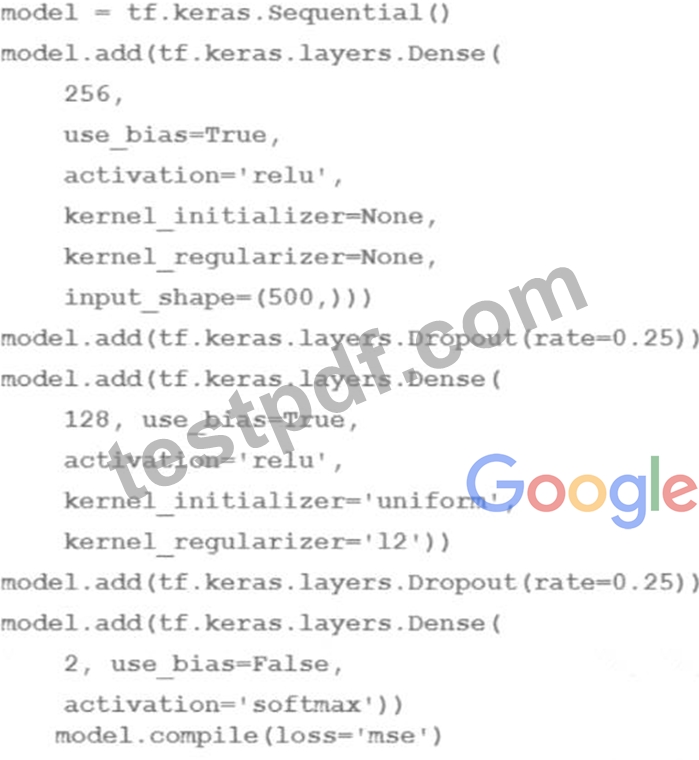
How many trainable weights does your model have? (The arithmetic below is correct.)
- A. 500*256+256*128+128*2 = 161024
- B. 501*256+257*128+2 = 161154
- C. 500*256*0 25+256*128*0 25+128*2 = 40448
- D. 501*256+257*128+128*2=161408
Answer: A
Explanation:
The number of trainable weights in a DNN regression model with Keras APIs can be calculated by multiplying the number of input units by the number of output units for each layer, and adding the number of bias units for each layer. The bias units are usually equal to the number of output units, except for the last layer, which does not have bias units if the activation function is softmax1. In this code, the model has three layers: a dense layer with 256 units and relu activation, a dropout layer with 0.25 rate, and a dense layer with 2 units and softmax activation. The input shape is 500. Therefore, the number of trainable weights is:
* For the first layer: 500 input units * 256 output units + 256 bias units = 128256
* For the second layer: The dropout layer does not have any trainable weights, as it only randomly sets some of the input units to zero to prevent overfitting2.
* For the third layer: 256 input units * 2 output units + 0 bias units = 512 The total number of trainable weights is 128256 + 512 = 161024. Therefore, the correct answer is B.
References:
* How to calculate the number of parameters for a Convolutional Neural Network?
* Dropout (keras.io)
NEW QUESTION # 119
You have recently trained a scikit-learn model that you plan to deploy on Vertex Al. This model will support both online and batch prediction. You need to preprocess input data for model inference. You want to package the model for deployment while minimizing additional code What should you do?
- A. 1 Wrap your model in a custom prediction routine (CPR). and build a container image from the CPR local model
2 Upload your sci-kit learn model container to Vertex Al Model Registry
3 Deploy your model to Vertex Al Endpoints, and create a Vertex Al batch prediction job - B. 1 Create a custom container for your sci-kit learn model.
2 Upload your model and custom container to Vertex Al Model Registry
3 Deploy your model to Vertex Al Endpoints, and create a Vertex Al batch prediction job that uses the instanceConfig. instanceType setting to transform your input data - C. 1 Upload your model to the Vertex Al Model Registry by using a prebuilt scikit-learn prediction container
2 Deploy your model to Vertex Al Endpoints, and create a Vertex Al batch prediction job that uses the instanceConfig.inscanceType setting to transform your input data - D. 1. Create a custom container for your sci-kit learn model,
2 Define a custom serving function for your model
3 Upload your model and custom container to Vertex Al Model Registry
4 Deploy your model to Vertex Al Endpoints, and create a Vertex Al batch prediction job
Answer: A
NEW QUESTION # 120
A Machine Learning Specialist is working with a large cybersecurity company that manages security events in real time for companies around the world. The cybersecurity company wants to design a solution that will allow it to use machine learning to score malicious events as anomalies on the data as it is being ingested. The company also wants be able to save the results in its data lake for later processing and analysis.
What is the MOST efficient way to accomplish these tasks?
- A. Ingest the data using Amazon Kinesis Data Firehose, and use Amazon Kinesis Data Analytics Random Cut Forest (RCF) for anomaly detection. Then use Kinesis Data Firehose to stream the results to Amazon S3.
- B. Ingest the data and store it in Amazon S3. Use AWS Batch along with the AWS Deep Learning AMIs to train a k-means model using TensorFlow on the data in Amazon S3.
- C. Ingest the data into Apache Spark Streaming using Amazon EMR, and use Spark MLlib with k-means to perform anomaly detection. Then store the results in an Apache Hadoop Distributed File System (HDFS) using Amazon EMR with a replication factor of three as the data lake.
- D. Ingest the data and store it in Amazon S3. Have an AWS Glue job that is triggered on demand transform the new data. Then use the built-in Random Cut Forest (RCF) model within Amazon SageMaker to detect anomalies in the data.
Answer: C
NEW QUESTION # 121
You are training models in Vertex Al by using data that spans across multiple Google Cloud Projects You need to find track, and compare the performance of the different versions of your models Which Google Cloud services should you include in your ML workflow?
- A. Dataplex. Vertex Al Experiments, and Vertex Al ML Metadata
- B. Vertex Al Pipelines: Vertex Al Experiments and Vertex Al Metadata
- C. Dataplex. Vertex Al Feature Store and Vertex Al TensorBoard
- D. Vertex Al Pipelines, Vertex Al Feature Store, and Vertex Al Experiments
Answer: D
Explanation:
Vertex AI Pipelines is a service that allows you to orchestrate and automate your machine learning (ML) workflows using pipelines1. A pipeline is a description of an ML workflow, including all of the components in the workflow, how the components are connected as a graph, and the runtime parameters that the pipeline accepts1. Vertex AI Pipelines helps you manage the end-to-end lifecycle of your ML projects, from data preprocessing to model deployment1.
Vertex AI Feature Store is a service that enables you to serve, share, and reuse ML features across different models and projects2. A feature is a measurable property or characteristic of an entity, such asthe age of a person or the price of a product2. Vertex AI Feature Store helps you reduce data duplication, ensure data consistency, and improve model performance2.
Vertex AI Experiments is a service that helps you track and compare the performance of different versions of your models3. You can use Vertex AI Experiments to run multiple training jobs with different hyperparameters, architectures, or data sources, and then compare the results using metrics, visualizations, and reports3. Vertex AI Experiments helps you identify the best model for your use case and optimize your model performance3. References:
* Vertex AI Pipelines | Google Cloud
* Vertex AI Feature Store | Google Cloud
* Vertex AI Experiments | Google Cloud
NEW QUESTION # 122
Machine Learning Specialist is training a model to identify the make and model of vehicles in images. The Specialist wants to use transfer learning and an existing model trained on images of general objects. The Specialist collated a large custom dataset of pictures containing different vehicle makes and models.
What should the Specialist do to initialize the model to re-train it with the custom data?
- A. Initialize the model with random weights in all layers and replace the last fully connected layer.
- B. Initialize the model with pre-trained weights in all layers including the last fully connected layer.
- C. Initialize the model with pre-trained weights in all layers and replace the last fully connected layer.
- D. Initialize the model with random weights in all layers including the last fully connected layer.
Answer: C
Explanation:
Explanation/Reference:
NEW QUESTION # 123
You received a training-serving skew alert from a Vertex Al Model Monitoring job running in production.
You retrained the model with more recent training data, and deployed it back to the Vertex Al endpoint but you are still receiving the same alert. What should you do?
- A. Temporarily disable the alert until the model can be retrained again on newer training data Retrain the model again after a sufficient amount of new production traffic has passed through the Vertex Al endpoint
- B. Update the model monitoring job to use a lower sampling rate.
- C. Temporarily disable the alert Enable the alert again after a sufficient amount of new production traffic has passed through the Vertex Al endpoint.
- D. Update the model monitoring job to use the more recent training data that was used to retrain the model.
Answer: D
Explanation:
The best option for resolving the training-serving skew alert is to update the model monitoring job to use the more recent training data that was used to retrain the model. This option can help align the baseline distribution of the model monitoring job with the current distribution of the production data, and eliminate the false positive alerts. Model Monitoring is a service that can track and compare the results of multiple machine learning runs. Model Monitoring can monitor the model's prediction input data for feature skew and drift.
Training-serving skew occurs when the feature data distribution in production deviates from the feature data distribution used to train the model. If the original training data is available, you can enable skew detection to monitor your models for training-serving skew. Model Monitoring uses TensorFlow Data Validation (TFDV) to calculate the distributions and distance scores for each feature, and compares them with a baseline distribution. The baseline distribution is the statistical distribution of the feature's values in the training data. If the distance score for a feature exceeds an alerting threshold that you set, Model Monitoring sends you an email alert. However, if you retrain the model with more recent training data, and deploy it back to the Vertex AI endpoint, the baseline distribution of the model monitoring job may become outdated and inconsistent with the current distribution of the production data. This can cause the model monitoring job to generate false positive alerts, even if the model performance is not deteriorated. To avoid this problem, you need to update the model monitoring job to use the more recent training data that was used to retrain the model. This can help the model monitoring job to recalculate the baseline distribution and the distance scores, and compare them with the current distribution of the production data. This can also help the model monitoring job to detect any true positive alerts, such as a sudden change in the production data that causes the model performance to degrade1.
The other options are not as good as option B, for the following reasons:
* Option A: Updating the model monitoring job to use a lower sampling rate would not resolve the training-serving skew alert, and could reduce the accuracy and reliability of the model monitoring job.
The sampling rate is a parameter that determines the percentage of prediction requests that are logged and analyzed by the model monitoring job. Using a lower sampling rate can reduce the storage and computation costs of the model monitoring job, but also the quality and validity of the data. Using a lower sampling rate can introduce sampling bias and noise into the data, and make the model monitoring job miss some important features or patterns of the data. Moreover, using a lower sampling rate would not address the root cause of the training-serving skew alert, which is the mismatch between the baseline distribution and the current distribution of the production data2.
* Option C: Temporarily disabling the alert, and enabling the alert again after a sufficient amount of new production traffic has passed through the Vertex AI endpoint, would not resolve the training-serving skew alert, and could expose the model to potential risks and errors. Disabling the alert would stop the model monitoring job from sending email notifications when the distance score for a feature exceeds the
* alerting threshold, but it would not stop the model monitoring job from calculating and comparing the distributions and distance scores. Therefore, disabling the alert would not address the root cause of the training-serving skew alert, which is the mismatch between the baseline distribution and the current distribution of the production data. Moreover, disabling the alert would prevent the model monitoring job from detecting any true positive alerts, such as a sudden change in the production data that causes the model performance to degrade. This can expose the model to potential risks and errors, and affect the user satisfaction and trust1.
* Option D: Temporarily disabling the alert until the model can be retrained again on newer training data, and retraining the model again after a sufficient amount of new production traffic has passed through the Vertex AI endpoint, would not resolve the training-serving skew alert, and could cause unnecessary costs and efforts. Disabling the alert would stop the model monitoring job from sending email notifications when the distance score for a featureexceeds the alerting threshold, but it would not stop the model monitoring job from calculating and comparing the distributions and distance scores.
Therefore, disabling the alert would not address the root cause of the training-serving skew alert, which is the mismatch between the baseline distribution and the current distribution of the production data.
Moreover, disabling the alert would prevent the model monitoring job from detecting any true positive alerts, such as a sudden change in the production data that causes the model performance to degrade.
This can expose the model to potential risks and errors, and affect the user satisfaction and trust.
Retraining the model again on newer training data would create a new model version, but it would not update the model monitoring job to use the newer training data as the baseline distribution. Therefore, retraining the model again on newer training data would not resolve the training-serving skew alert, and could cause unnecessary costs and efforts1.
References:
* Preparing for Google Cloud Certification: Machine Learning Engineer, Course 3: Production ML Systems, Week 4: Evaluation
* Google Cloud Professional Machine Learning Engineer Exam Guide, Section 3: Scaling ML models in production, 3.3 Monitoring ML models in production
* Official Google Cloud Certified Professional Machine Learning Engineer Study Guide, Chapter 6:
Production ML Systems, Section 6.3: Monitoring ML Models
* Using Model Monitoring
* Understanding the score threshold slider
* Sampling rate
NEW QUESTION # 124
You work for a company that sells corporate electronic products to thousands of businesses worldwide. Your company stores historical customer data in BigQuery. You need to build a model that predicts customer lifetime value over the next three years. You want to use the simplest approach to build the model and you want to have access to visualization tools. What should you do?
- A. Run the create model statement from the BigQuery console to create an AutoML model Validate the results by using the ml. evaluate and ml. predict statements.
- B. Create a Vertex Al Workbench notebook to perform exploratory data analysis. Use IPython magics to create a new BigQuery table with input features Use the BigQuery console to run the create model statement Validate the results by using the ml. evaluate and ml. predict statements.
- C. Create a Vertex Al Workbench notebook to perform exploratory data analysis and create input features Save the features as a CSV file in Cloud Storage Import the CSV file as a new BigQuery table Use the BigQuery console to run the create model statement Validate the results by using the ml. evaluate and ml. predict statements.
- D. Create a Vertex Al Workbench notebook to perform exploratory data analysis Use IPython magics to create a new BigQuery table with input features, create the model and validate the results by using the create model, ml. evaluates, and ml. predict statements.
Answer: D
NEW QUESTION # 125
You deployed an ML model into production a year ago. Every month, you collect all raw requests that were sent to your model prediction service during the previous month. You send a subset of these requests to a human labeling service to evaluate your model's performance. After a year, you notice that your model's performance sometimes degrades significantly after a month, while other times it takes several months to notice any decrease in performance. The labeling service is costly, but you also need to avoid large performance degradations. You want to determine how often you should retrain your model to maintain a high level of performance while minimizing cost. What should you do?
- A. Identify temporal patterns in your model's performance over the previous year. Based on these patterns, create a schedule for sending serving data to the labeling service for the next year.
- B. Compare the cost of the labeling service with the lost revenue due to model performance degradation over the past year. If the lost revenue is greater than the cost of the labeling service, increase the frequency of model retraining; otherwise, decrease the model retraining frequency.
- C. Run training-serving skew detection batch jobs every few days to compare the aggregate statistics of the features in the training dataset with recent serving data. If skew is detected, send the most recent serving data to the labeling service.
- D. Train an anomaly detection model on the training dataset, and run all incoming requests through this model. If an anomaly is detected, send the most recent serving data to the labeling service.
Answer: D
NEW QUESTION # 126
A company is using Amazon Polly to translate plaintext documents to speech for automated company announcements. However, company acronyms are being mispronounced in the current documents.
How should a Machine Learning Specialist address this issue for future documents?
- A. Convert current documents to SSML with pronunciation tags.
- B. Create an appropriate pronunciation lexicon.
- C. Use Amazon Lex to preprocess the text files for pronunciation
- D. Output speech marks to guide in pronunciation.
Answer: A
Explanation:
Explanation/Reference: https://docs.aws.amazon.com/polly/latest/dg/ssml.html
NEW QUESTION # 127
You are an ML engineer at a global car manufacturer. You need to build an ML model to predict car sales in different cities around the world. Which features or feature crosses should you use to train city-specific relationships between car type and number of sales?
- A. Two feature crosses as a element-wise product the first between binned latitude and one-hot encoded car type, and the second between binned longitude and one-hot encoded car type
- B. One feature obtained as an element-wise product between latitude, longitude, and car type
- C. Three individual features binned latitude, binned longitude, and one-hot encoded car type
- D. One feature obtained as an element-wise product between binned latitude, binned longitude, and one-hot encoded car type
Answer: D
Explanation:
https://developers.google.com/machine-learning/crash-course/feature-crosses/check-your-understanding
https://developers.google.com/machine-learning/crash-course/feature-crosses/video-lecture
https://developers.google.com/machine-learning/crash-course/feature-crosses/check-your-understanding
NEW QUESTION # 128
......
Earning the Google Professional Machine Learning Engineer Certification demonstrates to employers and clients that you have the skills and knowledge needed to design and implement effective machine learning solutions on the Google Cloud Platform. It is a valuable credential for data scientists, software engineers, and other professionals who are interested in developing their skills in machine learning and cloud computing.
Prepare for the Actual Google Cloud Certified Professional-Machine-Learning-Engineer Exam Practice Materials Collection: https://www.testpdf.com/Professional-Machine-Learning-Engineer-exam-braindumps.html
Google Cloud Certified Certification Professional-Machine-Learning-Engineer Sample Questions Reliable: https://drive.google.com/open?id=1xVyMsPLT__IqlGWauQPOIMh8YU4Yw_qn
