

[Oct-2021] Use Real AZ-140 Dumps Free Sample Questions and Practice Test Engine
Pass Microsoft AZ-140 exam - questions - convert Tets Engine to PDF
Exam AZ-140: Configuring and Operating Microsoft Azure Virtual Desktop
Candidates for this exam are administrators with subject matter expertise in planning, delivering, and managing virtual desktop experiences and remote apps, for any device, on Azure.
Responsibilities for this role include deploying virtual desktop experiences and apps to Azure. Professionals in this role deliver applications on Azure Virtual Desktop and optimize them to run in multi-session virtual environments. To deliver these experiences, they work closely with the Azure administrators and architects, along with Microsoft 365 Administrators.
Candidates for this exam should have experience in Azure technologies, including virtualization, networking, identity, storage, backups, resilience, and disaster recovery. They should understand on-premises virtual desktop infrastructure technologies as they relate to migrating to Azure Virtual Desktop. These professionals use the Azure portal and Azure Resource Manager templates to accomplish many tasks. This role may use PowerShell and Azure Command-Line Interface (CLI) for more efficient automation.
Candidates for this exam must have expert Azure administration skills.
Part of the requirements for: Microsoft Certified: Azure Virtual Desktop Specialty
How to Register For Exam AZ-140: Configuring and Operating Microsoft Azure Virtual Desktop?
NEW QUESTION 48
HOTSPOT
You have a Windows Virtual Desktop deployment.
You need to ensure that all the connections to the managed resources in the host pool require multi-factor authentication (MFA).
Which two settings should you modify in a conditional access policy? To answer, select the appropriate options in the answer area.
NOTE: Each correct selection is worth one point.
Hot Area:
Answer:
Explanation: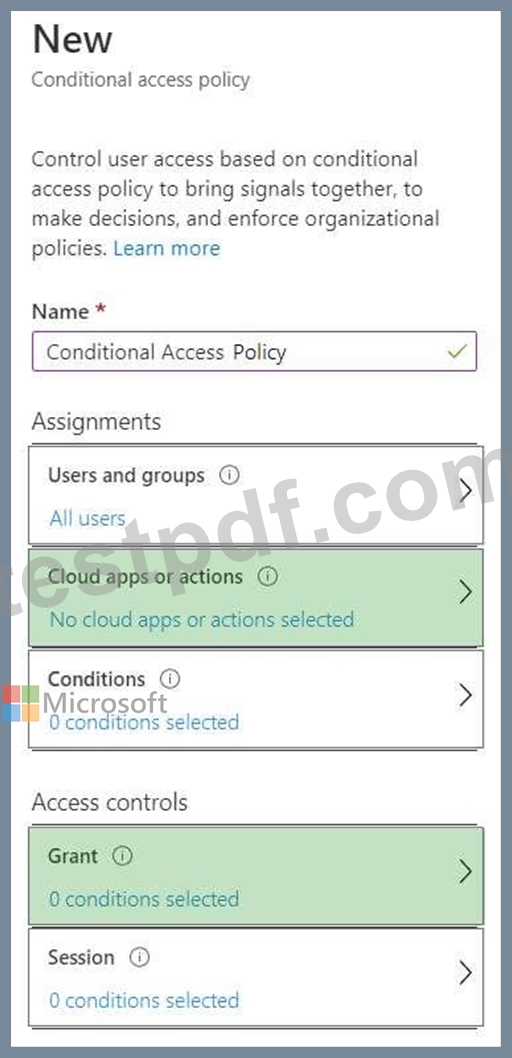
Explanation/Reference:
https://docs.microsoft.com/en-us/azure/active-directory/authentication/tutorial-enable-azure-mfa
NEW QUESTION 49
You have a Windows Virtual Desktop host pool named Pool1 that runs Windows 10 Enterprise multi-session hosts.
You need to use Performance Monitor to troubleshoot a low frame quality issue that is affecting a current use session to Pool1.
What should you run to retrieve the user session ID?
- A. Get-LocalUser
- B. whoami
- C. Get-ComputerInfo
- D. qwinsta
Answer: D
Explanation:
Reference:
https://docs.microsoft.com/en-us/azure/virtual-desktop/troubleshoot-vm-configuration
NEW QUESTION 50
You plan to deploy Windows Virtual Desktop.
Users have the devices shown in the following table.
From which device types can the users connect to Windows Virtual Desktop resources by using the Remote Desktop client app and the Remote Desktop web client? To answer, select the appropriate options in the answer area.
NOTE: Each correct selection is worth one point.
Answer:
Explanation:
Explanation
Reference:
https://docs.microsoft.com/en-us/azure/virtual-desktop/connect-web
https://docs.microsoft.com/en-us/azure/virtual-desktop/connect-android
https://docs.microsoft.com/en-us/azure/virtual-desktop/connect-macos
NEW QUESTION 51
You have a Windows Virtual Desktop deployment that contains the following:
* A host pool named Pool1
* Two session hosts named Host1 and Host2
* An application group named RemoteAppGroup1 that contains a RemoteApp named App1 You need to prevent users from copying and pasting between App1 and their local device.
What should you do?
- A. Modify the locks of RemoteAppGroup1.
- B. Modify the locks of RemoteAppGroup1.
- C. Create an AppLocker policy.
- D. Modify the RDP Properties of Pool1.
Answer: D
Explanation:
Reference:
https://docs.microsoft.com/en-us/azure/virtual-desktop/customize-rdp-properties
NEW QUESTION 52
You plan to deploy Windows Virtual Desktop session host virtual machines based on a preconfigured master image. The master image will be stored in a shared image.
You create a virtual machine named Image1 to use as the master image. You install applications and apply configuration changes to Image1.
You need to ensure that the new session host virtual machines created based on Image1 have unique names and security identifiers.
What should you do on Image1 before you add the image to the shared image gallery?
- A. At a command prompt, run the set computername command.
- B. From the lock screen of the Windows device, perform a Windows Autopilot Reset.
- C. At a command prompt, run the sysprep command.
- D. From PowerShell, run the rename-computer cmdlet.
Answer: C
Explanation:
Reference:
https://docs.microsoft.com/en-us/azure/virtual-machines/windows/prepare-for-upload-vhd-image#determinewhe
NEW QUESTION 53
You have an Azure Virtual Desktop deployment.
You use the Start/Stop VMs during off-hours feature in Azure.
You need to configure which virtual machines must never be stopped by the solution.
What should you configure?
- A. an Azure Automation account variable
- B. an action group
- C. the Start-Stop-VM task
- D. the Diagnostic settings of the host pool
Answer: A
Explanation:
Reference:
https://docs.microsoft.com/en-us/azure/automation/automation-solution-vm-management
https://docs.microsoft.com/en-us/azure/automation/automation-solution-vm-management-enable
NEW QUESTION 54
HOTSPOT
You have an Azure subscription that contains the virtual machines shown in the following table.
You create a shared image gallery as shown in the SharedGallery1 exhibit. (Click the SharedGallery1 tab.)
You create an image definition as shown in the Image1 exhibit. (Click the Image1 tab.)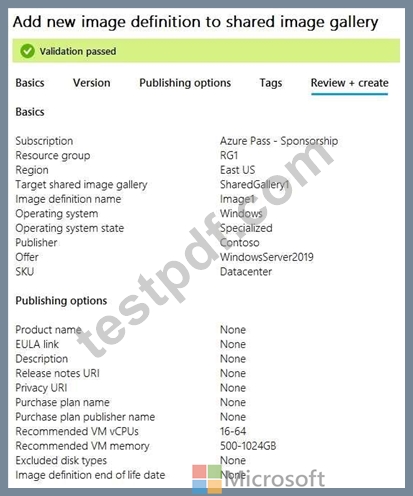
For each of the following statements, select Yes if the statement is true. Otherwise, select No.
NOTE: Each correct selection is worth one point.
Hot Area:
Answer:
Explanation:
Explanation/Reference:
https://www.robinhobo.com/windows-virtual-desktop-wvd-image-management-how-to-manage-and-deploy- custom-images-including-versioning-with-the-azure-shared-image-gallery-sig/
NEW QUESTION 55
Your company has a main office and two branch offices. Each office connects directly to the internet. The router in each branch office is configured as an endpoint for the following VPNs:
A VPN connection to the main office
A site-to-site VPN to Azure
The routers in each branch office have the Quality of Service (QoS) rules shown in the following table.
Users in the branch office report slow responses and connection errors when they attempt to connect to Windows Virtual Desktop resources.
You need to modify the QoS rules on the branch office routers to improve Windows Virtual Desktop performance.
For which rule should you increase the bandwidth allocation?
- A. Rule4
- B. Rule1
- C. Rule2
- D. Rule3
Answer: D
Explanation:
https://docs.microsoft.com/en-us/azure/virtual-desktop/safe-url-list
Any Remote Desktop clients you use must have access to the following URLs:
Remote Desktop clients
Address Outbound TCP port
*.wvd.microsoft.com 443
*.servicebus.windows.net 443
go.microsoft.com 443
aka.ms 443
docs.microsoft.com 443
privacy.microsoft.com 443
query.prod.cms.rt.microsoft.com 443
NEW QUESTION 56
You network contains an on-premises Active Directory domain. The domain contains a universal security group named WVDusers.
You have a hybrid Azure Active Directory (Azure AD) tenant. WVDusers syncs to Azure AD.
You have a Windows Virtual Desktop host pool that contains four Windows 10 Enterprise multi-session hosts.
You need to ensure that only the members of WVDusers can establish Windows Virtual Desktop sessions to the host pool.
What should you do?
- A. On each session host, add WVDusers to the local Remote Desktop Users group.
- B. Assign WVDusers to an application group.
- C. Assign WVDusers to an Azure role scoped to each host pool.
- D. Assign WVDusers to an Azure role scoped to the session hosts.
Answer: B
Explanation:
Reference:
https://docs.microsoft.com/en-us/azure/virtual-desktop/manage-app-groups
NEW QUESTION 57
Note: This question is part of a series of questions that present the same scenario. Each question in the series contains a unique solution that might meet the stated goals. Some question sets might have more than one correct solution, while others might not have a correct solution.
After you answer a question in this section, you will NOT be able to return to it. As a result, these questions will not appear in the review screen.
You have the following:
A Microsoft 365 E5 tenant
An on-premises Active Directory domain
A hybrid Azure Active Directory (Azure AD) tenant
An Azure Active Directory Domain Services (Azure AD DS) managed domain
An Azure Virtual Desktop deployment
The Azure Virtual Desktop deployment contains personal desktops that are hybrid joined to the on-premises domain and enrolled in Microsoft Intune.
You need to configure the security settings for the Microsoft Edge browsers on the personal desktops.
Solution: You configure a compliance policy in Intune.
Does this meet the goal?
- A. No
- B. Yes
Answer: A
Explanation:
You need to configure a Configuration Profile in Intune or use Group Policy.
NEW QUESTION 58
You have an Azure Virtual Desktop host pool. The pool contains session hosts that run Windows 10 Enterprise multi-session.
You connect to a Remote Desktop session on Pool1 and discover an issue with the frequency of screen updates.
You need to identify whether the issue related to insufficient server, network, or client resources. The solution must minimize how long it takes to identify the resource type.
What should you do?
- A. From within the current session, use Performance Monitor to display the values of all the RemoteFX Graphics(*)\Frames Skipped/Second counters.
- B. From Azure Cloud Shell, run the Get-AzOperationalInsightsWorkspaceUsage cmdlet and specify the DefaultProfile parameter.
- C. From within the current session, use the Azure Virtual Desktop Experience Estimator.
- D. From Azure Cloud Shell, run the Get-AzWvdUserSession cmdlet and specify the UserSessionId parameter.
Answer: A
NEW QUESTION 59
You network contains an on-premises Active Directory domain. The domain contains a universal security group named WVDusers.
You have a hybrid Azure Active Directory (Azure AD) tenant. WVDusers syncs to Azure AD.
You have a Windows Virtual Desktop host pool that contains four Windows 10 Enterprise multi-session hosts.
You need to ensure that only the members of WVDusers can establish Windows Virtual Desktop sessions to the host pool.
What should you do?
- A. On each session host, add WVDusers to the local Remote Desktop Users group.
- B. Assign WVDusers to an application group.
- C. Assign WVDusers to an Azure role scoped to each host pool.
- D. Assign WVDusers to an Azure role scoped to the session hosts.
Answer: B
Explanation:
Explanation/Reference:
https://docs.microsoft.com/en-us/azure/virtual-desktop/manage-app-groups
NEW QUESTION 60
Which two roles should you assign to Admin1 to meet the security requirements? Each correct answer presents part of the solution.
NOTE: Each correct selection is worth one point.
- A. Desktop Virtualization Workspace Contributor
- B. Desktop Virtualization Application Group Contributor
- C. User Access Administrator
- D. Desktop Virtualization Application Group Reader
- E. Desktop Virtualization Host Pool Contributor
Answer: A,B
Explanation:
Reference:
https://docs.microsoft.com/en-us/azure/virtual-desktop/rbac
NEW QUESTION 61
You plan to deploy Windows Virtual Desktop to meet the department requirements shown in the following table.
You plan to use Windows Virtual Desktop host pools with load balancing and autoscaling.
You need to recommend a host pool design that meets the requirements. The solution must minimize costs.
What is the minimum number of host pools you should recommend?
- A. 0
- B. 1
- C. 2
- D. 3
Answer: B
Explanation:
Reference:
https://docs.microsoft.com/en-us/azure/virtual-desktop/create-host-pools-azure-marketplace
3 Host Pools - The RemoteApp can be joinned inside the IT Multi-Session desktop or the Engineering. https://docs.microsoft.com/en-us/azure/virtual-desktop/manage-app-groups The default app group created for a new Azure Virtual Desktop host pool also publishes the full desktop. In addition, you can create one or more RemoteApp application groups for the host pool.
NEW QUESTION 62
You are automating the deployment of an Azure Virtual Desktop host pool.
You deploy the Azure Resource Manager (ARM) template shown in the following exhibit.
Use the drop-down menus to select the answer choice that completes each statement based on the information presented in the Dockerfile.
NOTE: Each correct selection is worth one point.
Answer:
Explanation:
Reference:
https://docs.microsoft.com/en-us/azure/virtual-desktop/virtual-desktop-fall-2019/configure-host-pool-personal-desktop-assignment-type-2019
NEW QUESTION 63
You have a shared image gallery that contains the Windows 10 images shown in the following table.
You create a Windows Virtual Desktop deployment that has the following settings:
Host pool name: Pool1
Location: West US
Host pool type: Personal
Which images can you use for the session hosts?
- A. Image1 and Image3 only
- B. Image2 only
- C. Image1, Image2, Image3, and Image4
- D. Image1 and Image2 only
- E. Image1 only
Answer: A
Explanation:
Reference:
https://azure.microsoft.com/en-in/blog/vm-image-blog-post/
NEW QUESTION 64
You have a Windows Virtual Desktop host pool named Pool1 and an Azure Storage account named Storage1.
Storage1 stores FSLogix profile containers in a share folder named share1.
You create a new group named Group1. You provide Group1 with permission to sign in to Pool1.
You need to ensure that the members of Group1 can store the FSLogix profile containers in share1. The solution must use the principle of least privilege.
Which two privileges should you assign to Group1? Each correct answer presents part of the solution.
NOTE: Each correct selection is worth one point.
- A. the Storage Blob Data Contributor role for storage1
- B. the Storage File Data SMB Share Elevated Contributor role for storage1
- C. the Modify NTFS permissions for share1
- D. the Storage File Data SMB Share Contributor role for storage1
- E. the List folder / read data NTFS permissions for share1
- F. the Storage File Data SMB Share Reader role for storage1
Answer: C,D
Explanation:
Reference:
https://docs.microsoft.com/en-us/azure/virtual-desktop/create-file-share
NEW QUESTION 65
DRAG DROP
You have a Windows Virtual Desktop deployment.
You have a session host named Host1 that has the disk layout shown in the exhibit. (Click the Exhibit tab.)
You plan to deploy an app that must be installed on D. The app requires 500 GB of disk space.
You need to add a new data disk that will be assigned the drive letter D. The solution must maintain the current performance of Host1.
Which four actions should you perform in sequence? To answer, move the appropriate actions from the list of actions to the answer area and arrange them in the correct order.
Select and Place:
Answer:
Explanation:
Explanation/Reference:
https://www.azurecorner.com/change-temporary-drive-azure-vm-use-d-persistent-data-disks/
NEW QUESTION 66
You need to evaluate the RDS deployment in the Seattle office. The solution must meet the technical requirements.
Which three actions should you perform in sequence? To answer, move the appropriate actions from the list of actions to the answer area and arrange them in the correct order.
Answer:
Explanation:
Explanation
Reference:
https://docs.microsoft.com/en-us/azure/cloud-adoption-framework/migrate/azure-best-practices/contoso-migratio
NEW QUESTION 67
You have an Azure Active Directory (Azure AD) tenant named contoso.com and an Azure virtual network named VNET1.
To VNET1, you deploy an Azure Active Directory Domain Services (Azure AD DS) managed domain named litwareinc.com.
To VNET1, you plan to deploy a Windows Virtual Desktop host pool named Pool1.
You need to ensure that you can deploy Windows 10 Enterprise host pools to Pool1.
What should you do first?
- A. Modify the DNS settings of VNET1.
- B. Add a custom domain name to contoso.com.
- C. Modify the settings of the litwareinc.com DNS zone.
- D. Implement Azure AD Connect cloud sync.
Answer: A
Explanation:
Reference:
https://docs.microsoft.com/en-us/azure/active-directory-domain-services/tutorial-create-instance
"Update DNS settings for the Azure virtual network With Azure AD DS successfully deployed, now configure the virtual network to allow other connected VMs and applications to use the managed domain. To provide this connectivity, update the DNS server settings for your virtual network to point to the two IP addresses where the managed domain is deployed."
NEW QUESTION 68
You have a Windows Virtual Desktop deployment.
You need to provide external users with access to the deployment. The external users have computers that run Windows 10 Pro and Windows 10 Enterprise. The users do not have the ability to install applications.
What should you recommend that the users use to connect to the deployment?
- A. Microsoft Edge
- B. Remote Desktop Connection
- C. Remote Desktop Manager
- D. RemoteApp and Desktop Connection
Answer: A
Explanation:
Explanation/Reference:
https://docs.microsoft.com/en-us/azure/active-directory/governance/entitlement-management-external-users
https://docs.microsoft.com/en-us/azure/virtual-desktop/connect-web
NEW QUESTION 69
You have an Azure Virtual Desktop deployment.
You deploy and configure Azure Virtual Desktop in a secondary location.
You plan to perform a test failover to the secondary location, but discover existing user sessions to the primary location.
You need to sign out users from the session hosts in the primary location.
Which PowerShell cmdlet should you run?
- A. Remove-Alias
- B. Invoke-RdsUserSessionLogoff
- C. Remove-AzWvdUserSession
- D. Invoke-RestMethod
Answer: C
Explanation:
Reference:
https://docs.microsoft.com/en-us/azure/virtual-desktop/disaster-recovery
NEW QUESTION 70
You need to implement network security to meet the security requirements and the performance requirements.
Which two actions should you perform? Each correct answer presents a complete solution.
NOTE: Each correct selection is worth one point.
- A. Deploy an Azure Firewall instance and Azure Firewall Manager.
- B. Filter traffic by using infrastructure rules.
- C. Deploy a network security group (NSG) and two application security groups.
- D. Filter traffic by using outbound rules.
- E. Deploy two Azure Firewall instances and Azure Firewall Manager.
- F. Filter traffic by using inbound rules.
Answer: D,E
Explanation:
Reference:
https://docs.microsoft.com/en-us/azure/firewall/protect-windows-virtual-desktop
NEW QUESTION 71
......
Skills measured
- Manage Access and Security (10-15%)
- Plan an Azure Virtual Desktop Architecture (10-15%)
- Implement an Azure Virtual Desktop Infrastructure (25-30%)
- Monitor and Maintain an Azure Virtual Desktop Infrastructure (20-25%)
- NOTE: The bullets that appear below each of the skills measured are intended to illustrate how we are assessing that skill. This list is NOT definitive or exhaustive.
- Manage User Environments and Apps (20-25%)
Pass Your AZ-140 Exam Easily - Real AZ-140 Practice Dump Updated Oct 23, 2021: https://www.testpdf.com/AZ-140-exam-braindumps.html
2021 Realistic Verified Free Microsoft AZ-140 Exam Questions : https://drive.google.com/open?id=1OjezWpTkbtq3ZproivYI_IxqYT0JZwD9
